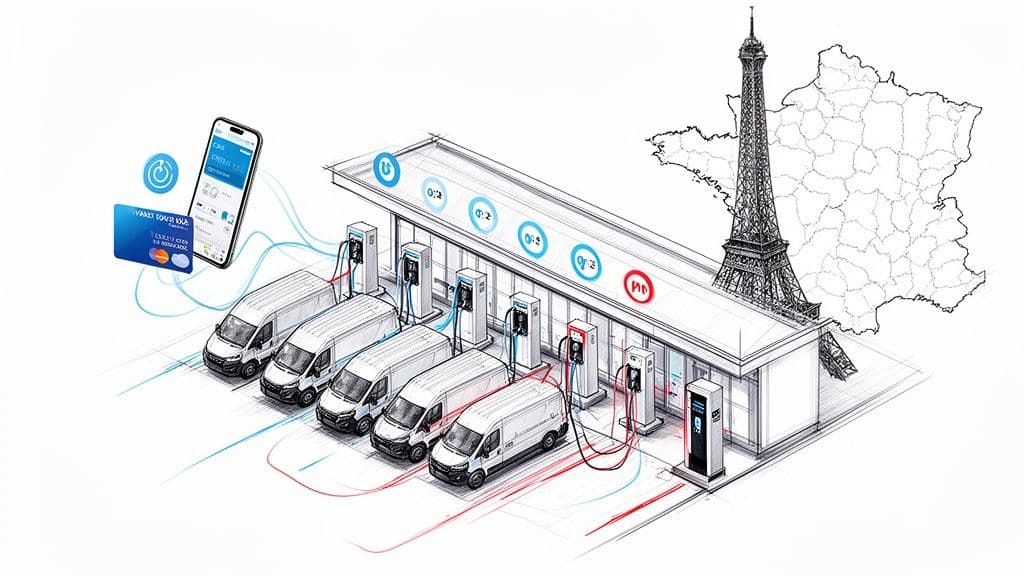
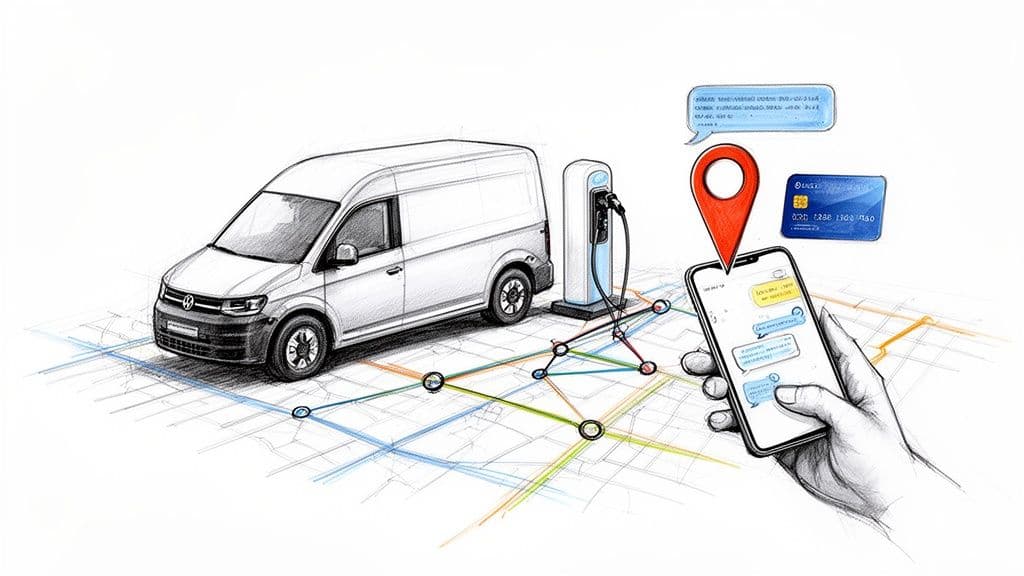
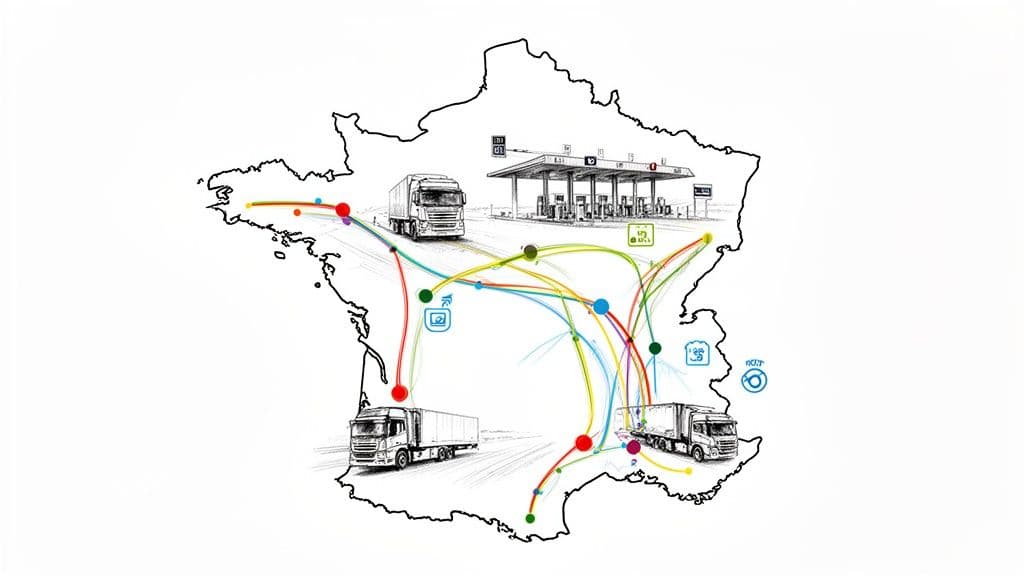
For any fleet looking to find the best EV charging solution in France, the goal is simple: find a unified platform. One that brings together near-universal payment acceptance, transparent pricing, and powerful controls for the back office.
The right system gets rid of the operational headaches—no more juggling a dozen apps or reconciling a pile of fragmented invoices. It’s about turning a complex challenge into a streamlined, cost-effective operation from day one and ultimately lowering the total cost of owning your electric vehicles.
Navigating the Challenges of Fleet Electrification in France
Switching a commercial fleet to electric vehicles in France opens up a maze of new challenges. The real problem isn't just buying the EVs; it's figuring out how to charge them efficiently across the European market. Without a smart strategy, fleets quickly run into major roadblocks that chip away at the return on their investment.
Many fleet managers quickly find out that the public charging network is a patchwork quilt. Each operator often demands its own app, RFID card, and payment method, creating a nightmare for drivers and administrators alike. This fragmentation creates real friction on the ground, as drivers waste valuable time just trying to figure out how and where they can plug in, a key problem fleets face when operating across borders.
The Problem of Cost Uncertainty
Beyond the operational snags, there's the massive issue of unpredictable costs. Public charging tariffs in France, and right across Europe, are notoriously opaque. What looks like a straightforward per-kWh price can suddenly inflate with all sorts of extra charges.
Hidden Roaming Fees: When a driver uses a charging card on a different network, steep markups often get slapped on without any clear warning.
Session and Idle Fees: Many operators add connection fees or penalise drivers for staying plugged in after their vehicle is fully charged.
Varying Tariffs: Prices can swing wildly based on the time of day, location, and charging speed, making it nearly impossible to budget effectively.
This lack of transparency means finance teams often get hit with surprise costs at the end of the month, making it incredibly difficult to accurately track the total cost of ownership.
Administrative Overload and Its Impact
The final piece of this puzzle is the huge administrative burden it creates. A fleet using multiple charging networks will get dozens of separate invoices, each in a different format. Reconciling these statements, chasing down missing receipts, and manually keying data into accounting systems is a time-consuming and error-prone mess.
This manual work can easily cut over 10 hours in manual work per month, pulling key staff away from more important, strategic tasks.
Rally Charge is built for fleets, not individual drivers: it’s designed to reduce total cost from day one by combining better commercial terms with a setup that avoids the usual operational friction (multiple apps, fragmented invoices, and unclear cost drivers). Instead of treating charging as a standalone workflow, it fits into how fleets actually operate—policy-driven, multi-entity, and finance-led.
Instead of treating charging as yet another workflow to manage, the best EV charging solution in France must integrate it into how fleets actually operate—driven by policies, managed across different teams, and led by financial oversight. Without a unified system to solve these core issues, the true benefits of going electric will always remain just out of reach.
Decoding Public Charging Networks and Hidden Costs
Evaluating public EV charging options across France and Europe can feel like you’re trying to learn a new language. As a fleet manager, you're suddenly juggling technical jargon, chargers that may or may not work, and a pricing structure that often keeps the true cost under wraps until the invoice lands. Getting a grip on these details is the first step to finding a charging solution that actually works for your fleet.
The first technical hurdle is getting your head around the difference between AC (Alternating Current) and DC (Direct Current) chargers. Think of it like filling a water tank: AC charging is your standard garden hose—slower, but perfectly fine for overnight top-ups at the depot. DC fast charging is more like a fire hose, blasting high power directly into the battery for a quick fill-up on the road.
While DC charging gets your drivers back on their routes faster, it comes at a much higher cost per kilowatt-hour (kWh). For fleets, it's all about striking the right balance. A driver stuck waiting for a slow AC charger mid-shift is lost productivity, but leaning too heavily on expensive DC chargers will absolutely shred your energy budget.
The Problem with Roaming and Interoperability
Once you venture across Europe, another major headache appears: roaming. In theory, roaming agreements are supposed to let a driver use one charge card across multiple networks. The reality? It’s often a "black box" of unpredictable costs that leaves fleet managers guessing.
When your driver uses their card on a partner network, the original provider often slaps a hefty markup on top of the base charging price. This roaming fee is rarely advertised upfront, leading to nasty surprises on your monthly bills. A single cross-border trip from France into Germany or the UK can result in invoices with wildly different rates for the exact same amount of energy, making any attempt at cost control feel futile.
This messy landscape forces fleets into a corner. You either arm your drivers with a glovebox full of different RFID cards and apps for every network imaginable, or you resign yourself to the opaque and inflated costs of roaming.
Exposing the Hidden Fees in Charging Tariffs
The per-kWh rate you see on the screen is rarely the final price you pay. The true cost of a public charging session is often bloated by a minefield of extra fees designed to catch you off guard. To manage your costs effectively, you have to know what to look for.
Here are the most common culprits to watch out for:
Session Fees: A flat fee just for plugging in, no matter how much energy you actually use.
Time-Based Charges: Some operators bill by the minute in addition to the energy consumed, penalising slower-charging vehicles.
Idle Fees: Punitive charges that kick in if a vehicle stays plugged in after its battery is full, blocking the charger for others.
Roaming Markups: As mentioned, these are the extra charges your main provider adds when you use a partner network.
Without a system that can break down these individual costs, you're essentially flying blind. You can't coach driver behaviour or build a smart charging strategy if you don't even know what’s driving your expenses.
Cost is clearer and often lower because pricing is structured to remove the common “black box” of roaming markups and hidden fees. EV charging is itemized per kWh based on the charge point operator’s tariff, and any idle/overstay fees are shown explicitly—so fleet teams can actually manage behavior and cost, rather than discovering surprises after month-end.
A genuinely fleet-first solution brings radical transparency to the table. Rally, for instance, itemises every single charge based on the charge point operator’s direct tariff. This means you see the base energy cost, any session fees, and all idle penalties laid out clearly on one consolidated statement. That level of detail transforms your charging data from a confusing expense report into a powerful tool for optimising your fleet’s entire cost of ownership.
Why a Unified Payment System Is a Game Changer
For fleet managers in France, the day-to-day reality of EV charging can feel a lot like juggling. Arming drivers with a messy collection of RFID cards, different charging apps, and a standard credit card just creates friction at every turn. This disjointed approach isn't just clunky; it's a direct hit to your driver's productivity and your bottom line.
The single most common headache for drivers is the dreaded "can't charge here" moment. They pull up to a public charger, low on battery and short on time, only to discover their specific card or app won't work. A unified payment system is the clear answer, designed to make charging as straightforward and dependable as filling up with diesel once was.
Eliminating Charging Failures with Dual Access
The secret to unlocking universal coverage is a dual-access strategy that gives drivers more than one way to pay. It’s all about building in a safety net to guarantee uptime for your fleet, no matter the brand, location, or payment tech at the charger.
Rally solves this by weaving two payment paths into one seamless system.
Universal Card Acceptance: A VISA-backed card works at any charging station with a payment terminal or that accepts card-on-file payments through an operator’s app. This one card delivers an incredible 99% acceptance rate across the UK, the EU, and beyond.
Deep Network Integration: Coverage is stronger because Rally uses two complementary access paths. Drivers can charge with the same Rally Visa card wherever the charger supports card payment (terminal) or card-on-file via the operator app, while Rally Charge adds deeper network integrations for cases where card/app payment isn’t available—plus options like remote session start via WhatsApp and an optional RFID fob. This reduces “can’t charge here” edge cases without locking the fleet into a single app or a single network.
This combination truly is a game changer. It systematically gets rid of the frustrating edge cases that leave drivers stranded, transforming public charging from a roll of the dice into a reliable operational tool.
Reclaiming Your Administrative Time
Beyond the driver's experience, the administrative fallout from a fragmented payment system is immense. Finance teams are left chasing down dozens of separate invoices from various charging operators every single month. They have to manually stitch these different statements together, a process that is not only painful but also ripe for error.
Operationally, Rally is better because charging is not a separate portal: it’s part of a single fleet spend platform with real-time reporting, consolidated statements, granular controls by driver/vehicle, and integrations (APIs, accounting/ERP exports, and telematics links) that let you connect charging spend to utilization and mileage. That combination is what unlocks higher-level fleet insights (e.g., where charging time, pricing, or driver behavior is driving cost) and gives managers levers to act immediately.
Bringing all charging transactions into one platform wipes this burden away completely. Instead of a mountain of paperwork, you get a single, itemised statement. This simple automation consistently cuts over 10 hours of manual administrative work per month. That’s precious time your team can put back into optimising fleet performance instead of just wrestling with receipts. For a detailed breakdown of different options, explore our guide to electric car charging cards in Europe.
This unified approach goes beyond just EV charging, too. The same system can cover every fleet expense, including fuel for hybrid vehicles, parking, tolls, and even day-to-day business purchases. By consolidating multiple tools into one, you not only save money on software subscriptions but also gain a powerful, single source of truth for all your fleet's spending. This gives you the insights needed to find even more savings and truly master your total cost of ownership.
Driving Down the Total Cost of EV Fleet Ownership
For any fleet manager with an eye on the bottom line, the price per charge is only a tiny part of the story. The only metric that truly matters is the Total Cost of Ownership (TCO). Getting to the lowest TCO means looking beyond the sticker price of a charging session and embracing a system that delivers real savings through radical cost transparency and smarter operations.
This is exactly where a unified platform like Rally changes the game, delivering an average saving of 5-10% on total fleet energy costs. Instead of fuzzy, opaque billing, every single charge is itemised per kWh based on the charge point operator’s direct tariff. That means hidden roaming markups are gone for good.
Radical Transparency in Pricing
The biggest headache with many charging solutions in the European market is the pricing “black box.” Fleet managers get hit with inflated invoices at the end of the month, with no clear breakdown of what they’re actually paying for. It’s impossible to manage driver behaviour or control costs effectively when you can't see where the money is going.
Rally smashes open that black box by providing complete clarity on every transaction.
No Hidden Markups: You pay the operator's direct rate per kWh, without the hidden fees common in roaming agreements.
Explicit Idle Fees: Any overstay or idle fees are shown as separate line items. This lets you pinpoint and address the specific behaviours driving up costs.
Access to Low-Cost Networks: The system actively guides drivers toward more affordable fuel and charging stations, helping to lower your average energy bill.
This level of detail transforms billing from a monthly headache into a powerful management tool.
A Fairer, More Accessible Financial Model
Traditional fleet solutions often put up financial barriers that penalise growing businesses. Demands for large upfront deposits or strict credit checks can lock fleets out of the best solutions, forcing them into less efficient, higher-cost alternatives. The best EV charging solution in France should empower fleets, not hold them back.
Rally is built for fleets, not individual drivers. It’s designed to slash total costs from day one by combining better commercial terms with a setup that gets rid of the usual operational friction—think multiple apps, fragmented invoices, and unclear cost drivers.
This fleet-first approach is reflected in a more accessible commercial structure. Rally's prepaid option requires no refundable security deposit or personal credit check, but business and representative verification still applies. Postpaid terms require separate approval and may involve credit or security requirements, and fees are disclosed clearly.
The infographic below shows the stark contrast between the old, fragmented payment methods and the simplicity of a new, unified system.
This shift doesn't just simplify payments; it untangles the entire financial workflow.
Using multiple apps and payment methods for EV charging creates a messy administrative nightmare. A unified platform consolidates everything, making life easier for both drivers and the finance team. The table below breaks down the difference.
Traditional EV Charging vs A Unified Platform
Feature
Traditional Multi-App Approach
Rally's Unified Solution
Payment Method
Multiple apps, RFID cards, and credit cards for different networks.
One card and a single driver-friendly interface for all transactions.
Driver Experience
Confusing and frustrating; drivers juggle apps and logins.
Simple and consistent; one way to pay everywhere.
Invoicing
A flood of separate invoices from various operators each month.
One consolidated, itemised invoice for all charging sessions.
Cost Transparency
Hidden roaming fees and markups are common and hard to track.
Direct operator tariffs with no hidden fees. Complete cost clarity.
Admin Workload
Hours spent manually reconciling dozens of invoices and receipts.
Drastically reduced admin time with all data in one place.
Financial Controls
Difficult to enforce spending policies across different systems.
Centralised controls to set limits and monitor usage in real-time.
By moving away from the chaos of multiple apps, you reclaim valuable time and gain a much clearer picture of your fleet's energy spend.
A single payment system streamlines transactions significantly. It also reduces the manual work that usually comes with fragmented charging, receipt collection, and reimbursement processes. Ultimately, by combining transparent pricing, access to low-cost energy, and an accessible financial model, a unified platform offers the most direct path to lowering your fleet's total cost of ownership across France and Europe.
Tying It All Together: From the Driver's Seat to the Balance Sheet
The right EV charging solution doesn't just pay for a charge; it streamlines your entire operation, connecting the driver on the road to the finance team closing the books. A truly effective platform has to work for everyone in the business. It must be simple enough for a driver to use in seconds, powerful enough for a manager to control costs, and seamless enough for finance to reconcile without a headache.
This holistic approach is becoming mission-critical as public charging networks explode. As networks in France and across Europe see massive growth, a single, simple way to access them all isn't just a nice-to-have, it's a necessity. This includes access to one of the biggest EV networks in Europe, covering over 20 countries.
Making Life Easier for the Driver
For drivers, simplicity is king. The last thing they need is a glovebox stuffed with different RFID cards or a phone bogged down with a dozen charging apps, each demanding its own login and payment details. This mess of options just leads to wasted time and frustration, which directly hits your fleet's productivity.
The best solution cuts through all that noise. Rally, for example, offers EV charging via WhatsApp—no app download necessary. Drivers don't have to struggle with downloading apps or having logins. Paired with an optional RFID fob, it creates an experience that's about as straightforward as it gets. Drivers can pull up, plug in, and get back on the road without fumbling with unfamiliar tech.
Empowering Managers with Real Control
For fleet managers, it all comes down to control and visibility. A powerful dashboard that pulls all charging and spending data into one place is an absolute game-changer. It turns a flood of raw transactions into clear, actionable intelligence, showing you exactly where, when, and how your budget is being spent in real-time.
This central command centre unlocks a whole new level of operational grip:
Set smart spending rules: Create granular policies by driver, vehicle, or team to stop overspending before it even happens.
Monitor performance in real-time: Track charging patterns, energy consumption, and other key metrics to spot opportunities for improvement.
Analyse and optimise: Use detailed reports to pinpoint cost drivers—like repeat idle fees or a heavy reliance on pricey fast chargers—and fine-tune your strategy.
When you combine real-time reporting, consolidated statements, and granular controls, you start to uncover next-level fleet insights. It gives managers the tools to act on data instantly, directly connecting charging spend to vehicle utilisation and mileage.
A Seamless Workflow for the Finance Team
Finally, the platform has to solve the administrative nightmare for your finance department. Chasing down invoices from dozens of charging operators and manually punching data into accounting software is a huge time-drain, easily eating up over 10 hours of manual work every month.
A top-tier solution makes this pain disappear. By integrating directly with most major European accounting and ERP systems, it automates the entire reconciliation process. Consolidated statements and automated invoice processing mean no more manual data entry, fewer errors, and a much faster month-end close. No more chasing invoices, it's all in one place.
The system pulls everything into one place—not just EV charging but also fuel, tolls, parking, and even daily office expenses. This single-platform approach is not only more cost-effective but also gives you a complete, unified view of all business spending. For a deeper dive into optimising your financial workflows, check out our guide on European fleet expense management. This integration is the final piece of the puzzle, creating a truly streamlined operational flow that works for everyone, from the director's office to the driver's seat.
Your Guide to EV Fleet Charging in France
Switching your fleet to electric in France brings up a lot of practical questions. As a fleet manager, you're not just thinking about the vehicles, but the entire operational puzzle of keeping them charged and on the road. This guide tackles the most common challenges head-on, with straightforward answers that show how a single, smart platform can smooth out the transition.
How Can My Fleet Charge if a Public Charger Doesn't Accept Cards?
This is a classic headache that can grind a driver's day to a halt. You pull up to a public charger, ready to plug in, only to find it doesn't take standard payment cards. The best way to sidestep this problem is with a dual-access system.
Think of it like having two keys for the same lock. A VISA-backed card, for instance, works at any charger that has a card terminal or a payment app. But for the thousands of chargers that don't, deeper network integrations allow a driver to start a charge using something as simple as WhatsApp or an optional RFID fob. This combined approach, covering over 20 European countries, means your drivers will almost always have a way to pay, dramatically cutting down on failed charging attempts.
How Do I Control Driver Spending on Charging and Other Expenses?
When your drivers are out in the field, you need to trust them, but you also need to control your budget. A unified platform gives you a central dashboard with all the levers you need.
Fleet managers can set specific spending limits for each driver or vehicle, lock down payment categories to allow only EV charging and tolls, for example, and even define what times of day the card can be used. Every transaction pops up in real-time, so you can spot and stop budget overruns before the month-end report gives you a nasty surprise.
Instead of treating charging as a standalone workflow, the best solution fits into how fleets actually operate—policy-driven, multi-entity, and finance-led. It provides the levers to manage behaviour and cost, rather than discovering surprises after month-end.
Is It Difficult to Integrate EV Payments into Our Accounting Software?
It shouldn't be. With the right platform, it’s practically seamless. A system like Rally is built to plug directly into the major European accounting and ERP systems your finance team already uses.
This direct connection automates the whole reconciliation process. No more manual data entry, no more chasing receipts. Your finance team gets clean, consolidated spending data fed right into their software. For many businesses, this can claw back over 10 hours of manual work every month and slash the risk of human error.
Can a Single Fleet Card Handle More Than Just EV Charging?
Absolutely, and it should. The best EV charging solution in France isn’t just a charging card; it’s an all-in-one expense management platform.
The same system should cover everything from fuel for your remaining petrol or diesel vehicles to tolls, parking, maintenance, and even daily business expenses. This consolidation means you can ditch multiple tools and subscriptions, simplifying operations for everyone and cutting your overall software costs. To dive deeper, you can check out our overview of different types of fleet EV chargers and how to manage them all effectively.
Ready to eliminate charging headaches and gain full control over your fleet's expenses? Discover how Rally provides the cheapest EV charging in Europe with a single, unified platform. Learn more and get started today.