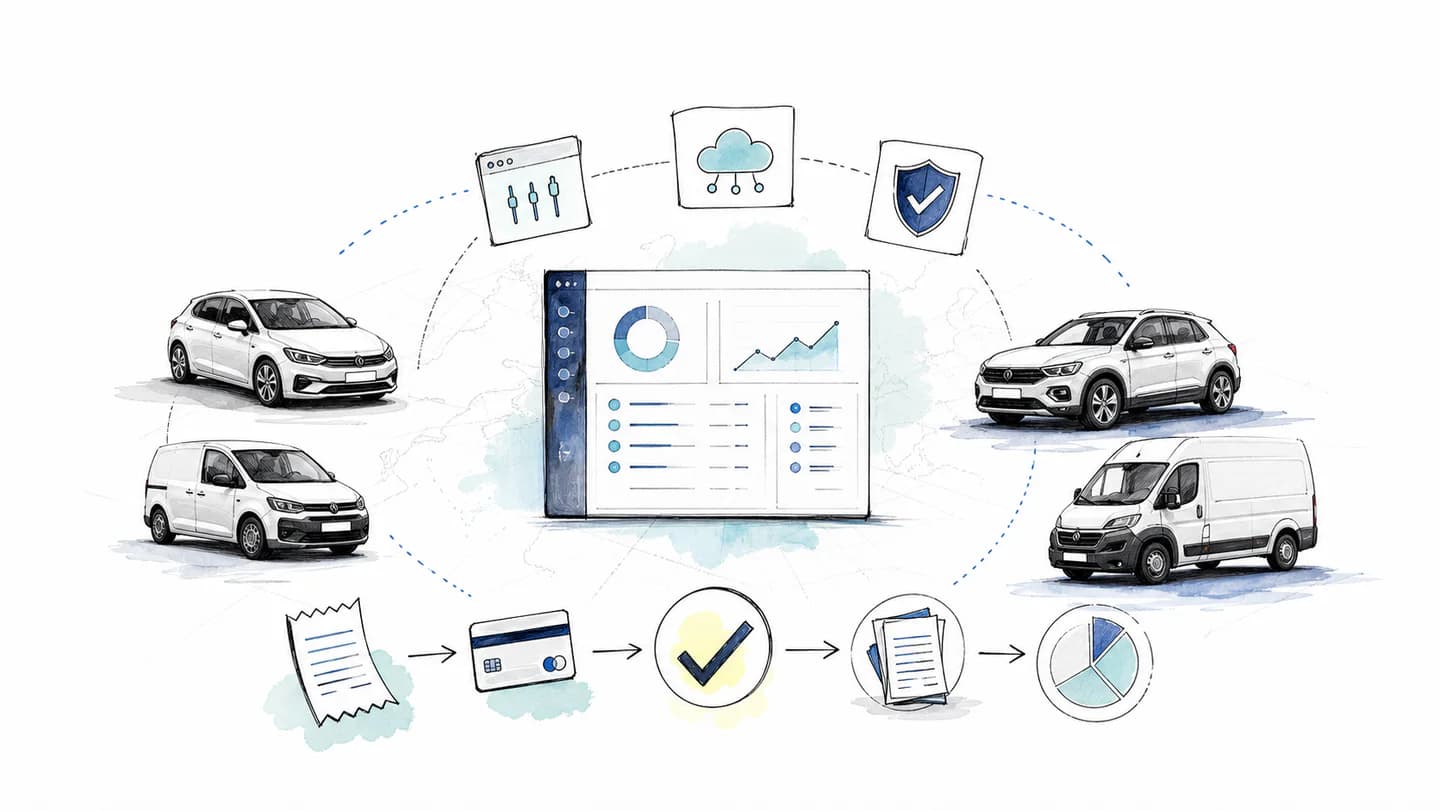
European fleet expense management is the process of controlling, documenting and reconciling every cost created by vehicles and drivers. That includes fuel, public EV charging, tolls, parking, maintenance, mileage, reimbursements and other company purchases.
The software should do more than store receipts. It should apply policy before or when money is spent, connect each transaction to the right driver or vehicle and give finance a clean record for review and accounting.
This guide explains the operating model and the questions to ask before buying. For a vendor shortlist, use our separate comparison of the best expense management software for fleets. If you are evaluating Rally directly, see the expense management platform.
Why fleet expenses are difficult to control
Fleet spend is fragmented by design. One journey can create fuel or charging costs, a toll, parking and an unexpected repair. Some payments arrive through cards, some through supplier invoices and others through employee claims. Cross-border routes add currencies, local tax treatment and different supporting documents.
The resulting admin is rarely one large task. It is a stream of small handoffs:
- A driver pays but does not submit the receipt.
- A card transaction arrives without a vehicle, job or cost centre.
- Finance has to decide how to code an unfamiliar merchant.
- A manager sees an exception after the money has left the business.
- Fuel and EV charging sit in separate systems, so nobody has a complete cost view.
Spreadsheets can record this history, but they cannot enforce a rule at purchase or create missing context. The hidden cost is therefore not just data entry. It is delayed decisions, weak accountability and time spent reconstructing transactions.
What good fleet expense software changes
The strongest platforms replace after-the-fact repair work with controls and structured evidence.
| Workflow | Manual or fragmented setup | Controlled software setup |
|---|
| Payment | Drivers use several cards or claim costs later | Approved spend follows defined card and policy rules |
| Evidence | Finance chases paper receipts and email attachments | Drivers submit evidence close to the transaction |
| Allocation | Teams match spend to vehicles and cost centres manually | Driver, vehicle, entity and category context travel with the transaction |
| Review | Managers approve a complete report at month end | The system blocks, flags or routes exceptions when they occur |
| Accounting | Finance exports, cleans and rekeys data | Reviewed transactions and documents flow into accounting |
| Reporting | Fuel, charging and other costs stay in separate systems | Fleet and finance share one view of operating spend |
The goal is not to remove human oversight. It is to direct attention towards exceptions, trends and decisions instead of routine matching.
Six capabilities to prioritise
Point-of-purchase controls
Useful controls act before reconciliation. Check whether managers can set limits and rules by driver, vehicle, merchant category, time or operating entity. The system should also provide a clear route for legitimate exceptions without forcing teams to weaken the policy for everyone.
Ask vendors to demonstrate a declined purchase, a temporary approval and a policy change. A dashboard that only reports a breach later is visibility, not prevention.
Driver and vehicle context
Generic employee expense tools often stop at the cardholder and cost centre. Fleets also need to know which vehicle, route, depot or job created the cost.
That link makes vehicle-level analysis possible and helps managers investigate unusual activity. It also prevents shared payment methods from erasing accountability.
Receipt and invoice capture that drivers will use
Receipt capture is only valuable when it fits field behaviour. Count the steps from payment to submission. Check what happens when a document is missing, unreadable or submitted against the wrong transaction.
Optical character recognition can extract data, but extraction alone is not the outcome. The platform should match evidence to the payment, retain the source document and show any correction in an audit trail. For supplier-heavy workflows, compare the separate requirements in our automated invoice processing guide.
Fuel, EV charging and road costs in one model
Mixed fleets should not need a different expense process for each energy type. Fuel and public charging need to sit alongside tolls, parking, maintenance and general business spend, with consistent driver and vehicle allocation.
Test the full payment journey, not only whether the card is accepted. A general payment card may work at a charger or fuel station while still providing none of the vehicle, energy or evidence data a fleet team needs.
Cross-border and multi-entity support
Country coverage is more than the places where a card can be used. Confirm where cards can be issued, which legal entities can join, how currencies and fees are handled, and whether local teams can keep their own policies inside group-level reporting.
Product availability and terms can differ by country and plan. Ask the vendor to document the exact UK and EEA setup it proposes for your entities rather than relying on a general “European coverage” claim.
Accounting and audit trails
The handoff to finance is where a polished expense workflow often breaks. Test the real accounting export or integration with your chart of accounts, tax codes, entities and approval statuses.
A useful system preserves the original evidence, the transaction, the policy decision and any later correction. Finance should be able to understand why a record reached the ledger without reconstructing its history across several tools.
Market-specific setup for four countries
One platform can support all four markets, but one configuration cannot. VAT treatment, private use, mileage, invoice evidence, retention and accounting integrations vary by country and sometimes by vehicle or fuel type. Each subsection below describes the named country rather than the reader's location.
United Kingdom
For UK entities, configure and verify UK VAT evidence, road-fuel and private-use treatment, mileage or reimbursement policy and accounting outputs.
Netherlands
For entities in the Netherlands, configure and verify Dutch bookkeeping fields, VAT and private-use adjustments and the accounting systems used by Dutch finance teams.
Germany
For German entities, configure and verify invoice and audit-trail requirements, retention settings, DATEV or other German accounting workflows and mileage or travel-expense policy where relevant.
France
For French entities, configure and verify accounting outputs, supporting-document requirements and configurable French VAT treatment for each relevant vehicle and energy category.
Treat these as implementation questions, not marketing checkboxes. Ask a local finance or tax owner to approve each configuration before rollout. Expense software can preserve evidence and apply the rules you give it; it cannot decide that every transaction is deductible or compliant.
Search terminology also differs by market. These examples describe the named market rather than the reader's location:
- For UK search research, investigate “expense management software”.
- For Dutch search research, investigate “declaratiesoftware” and “expense management”.
- For German search research, distinguish “Ausgabenmanagement” from travel-expense and “Reisekosten” workflows.
- For French search research, investigate “logiciel de notes de frais” and “gestion des dépenses”.
Localised pages should use the term that matches the workflow instead of translating the English headline word for word.
How to choose the right platform
Start with the workflow you need to remove, then test vendors against it.
- Map every spend channel. List cards, reimbursements, fuel and charging providers, toll accounts, invoices and accounting exports.
- Define the control model. Decide which purchases should be allowed, blocked or approved by driver, vehicle, category, time and entity.
- Check country and entity eligibility. Confirm issuance, support, currencies and contractual terms for every operating market.
- Run real transactions. Test fuel, charging, tolls, parking and an unexpected vehicle cost with actual drivers.
- Test failure cases. Include a missing receipt, a declined purchase, an incorrect category and a cross-border merchant.
- Push the result into accounting. Do not stop the pilot at the expense dashboard.
- Calculate the complete cost. Include subscriptions, card and transaction fees, implementation, retained systems and internal administration.
Driver experience should be part of the score. A workflow that looks efficient to finance but adds several steps in the field will recreate missing evidence and reimbursement work downstream.
How to measure the return
Avoid generic savings percentages. Record a baseline before rollout, then compare the same measures after the pilot:
- Missing-receipt rate
- Transactions requiring manual correction
- Reconciliation hours for fleet and finance
- Out-of-policy or unallocated spend
- Time from transaction to approved accounting record
- Number and cost of separate systems still required
The platform creates value when it removes leakage, admin or another system. Faster receipt uploads alone are not enough if finance still cleans the data and fuel, charging or vehicle records remain elsewhere.
A practical rollout plan
Begin with a small group that represents the real operation: different drivers, vehicle types, routes and countries. Map categories and approval rules before issuing access, and agree how exceptions will be handled.
During the pilot, measure the workflow from purchase to ledger. Ask drivers where they hesitated. Ask fleet managers which context was missing. Ask finance which records still needed repair.
Only expand after the complete flow works. Country-by-country configuration is usually safer than reusing one country's setup in the other three and correcting it later.
Where Rally fits
Rally brings Visa-powered physical and virtual cards, driver and vehicle controls, fuel, public EV charging and wider company spend into one platform. Drivers can send receipts through WhatsApp, while finance teams can review matched evidence and connect approved data to accounting workflows.
That fleet-first model is most relevant when payments, vehicles and finance currently sit in separate systems. It may be less suitable if the main requirement is travel booking or a broad procurement suite with little vehicle activity.
Explore the expense management platform, review the accounting workflow, or book a demo using your own fleet process.