Nick Telecki is Rally’s CEO and writes about AI expense management, business cards, fuel spending and cross-border business operations.
Frequently Asked Questions
A fuel card is a business payment card that lets drivers pay for fuel while the company controls limits, sees transactions, and receives cleaner invoices. Modern fleet cards such as Rally also cover EV charging, tolls, parking, receipts, and other approved vehicle expenses.
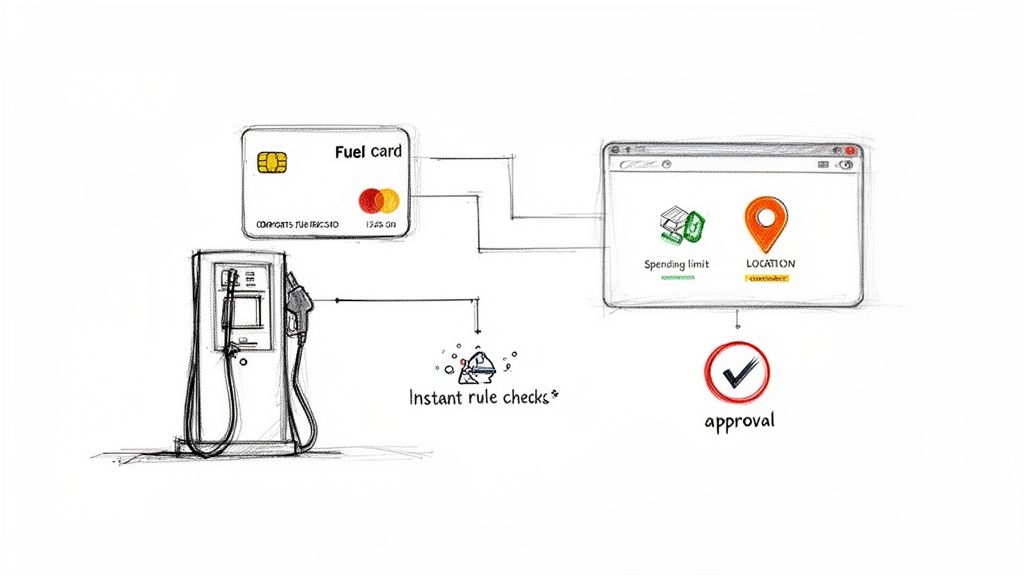
A driver uses the card at a fuel station, the transaction is checked against company rules, and the payment data flows into a dashboard or invoice. With Rally, receipts can be sent through WhatsApp and matched automatically for accounting.
A traditional fuel card usually pays for petrol or diesel inside a provider network. A fleet card covers a wider set of vehicle and driver expenses, including fuel, EV charging, tolls, parking, maintenance, receipts, and accounting data.
Never do your expenses again
Rally's AutoMatch agent handles everything for you
Let's start with a clear answer to "what is a fuel card?" A fuel card is a specialised business payment card that lets drivers pay for petrol, diesel and other vehicle expenses without using cash or personal cards. Think of it as a company debit card for fleet spend, but with limits, reporting, receipts and accounting controls built in.
Why Fleets Use Fuel Cards
For fleet managers across Europe, fuel is the second-largest operational cost and the hardest to see clearly. Paying with personal cards and paper receipts wastes time and creates three concrete problems:
Fragmented Spending Data: Payments are scattered across personal cards, petty cash, and various supplier accounts, making it impossible to get a clear picture of your fleet's expenditure.
Administrative Overload: Manually collecting, verifying, and entering receipt data is a massive time drain. Businesses often cut over 10 hours in manual work per month just by moving to an automated system.
Risk of Fraud and Misuse: With cash or standard credit cards, it's difficult to prevent unauthorised purchases or fuel theft, leaving your budget vulnerable.
How a Fuel Card Fixes This
A fuel card addresses all three. A driver pays at the station, the transaction is checked against rules you set (spending limits, approved locations), and the data flows into one dashboard. For the step-by-step mechanics, see our guide on how a fuel card works in practice.
The result is proactive control instead of month-end surprises. A VISA-backed card with 99% acceptance across Europe also removes the need to find specific branded stations, which matters most on cross-border routes. If you already need a provider, compare the best UK fuel card companies or see how Rally business fuel cards work for companies and fleets.
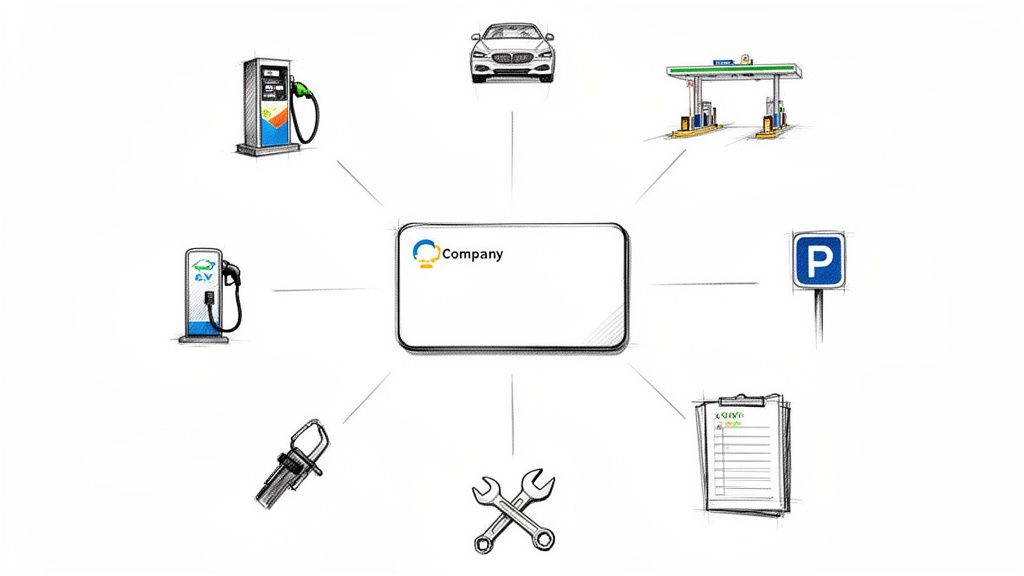
The core value of a modern fleet card lies in its ability to consolidate multiple tools into one platform. It’s not just for fuel anymore; it works for any type of expense: Parking, Tolls, Fuel, Charging, but also office expenses and anything to run the business day-to-day. It eliminates the need for a separate expense management tool and simplifies operations for everyone, from directors to drivers.
Instead of chasing invoices, transaction data can be automated and sent through direct accounting integration. Rally offers access to low-cost fuel stations and transparent fees. It is prepaid, with no refundable deposit or personal credit check.
Traditional Fuel Card vs Modern Fleet Card at a Glance
To really see the difference, it helps to put the old and new side-by-side. The table below shows just how far fleet payment solutions have come.
Feature
Traditional fuel card
Modern fleet card
Acceptance
Limited to specific fuel station networks
Universal acceptance, such as the Visa network
Expense scope
Primarily fuel and sometimes car wash
Fuel, EV charging, tolls, maintenance, and other approved business costs
Control
Basic PIN and end-of-month reporting
Real-time, customisable rules for limits, locations, and times
Data visibility
Delayed transaction data, often on monthly invoices
Instant transaction alerts and a live dashboard
Admin process
Manual receipt collection and reconciliation
Automated receipt capture via WhatsApp and transaction matching
Pricing model
Can include markups, network fees, and hidden costs
Transparent fees with access to low-cost stations
EV charging
Separate card or limited partner network
Fuel and EV charging managed on a single card and platform
Integration
Limited or manual data export
Structured CSV, Excel, JSON and DATEV-format exports
Ultimately, while traditional cards were a step up from cash, modern fleet cards represent a complete evolution. They're not just for payment; they're intelligent platforms for managing your entire fleet's spend efficiently and securely.
The Hidden Costs of Manual Expense Management
Managing fleet expenses manually drains time, money, and control. Finance teams chase paper receipts, decode scribbled notes, and key data into spreadsheets — and automating that work typically gives back over 10 hours a month that could go to analysis instead of data entry.
Fragmented spending data
When drivers pay with personal cards, petty cash, or a mix of supplier accounts, there is no single source of truth. You cannot build a real-time picture of fleet spend, so budgeting, forecasting, and spotting savings all become guesswork on data that is weeks out of date — for what is often your second-biggest operating cost.
Imagine a logistics company with dozens of drivers refuelling across several countries every day. Without a unified system, the finance manager only sees the total damage weeks later—long after the chance to correct overspending or guide drivers to cheaper stations has vanished.
Exposure to fuel fraud
Manual expense management leaves you exposed to fraud. With paper receipts, misuse is hard to catch until well after the fact, because checking every receipt for anomalies is not realistic at volume. The common types a fuel card is designed to stop:
Unauthorised Purchases: A driver uses a company card to buy snacks or other non-work items at a service station, which easily get lost among a pile of legitimate fuel receipts.
Personal Vehicle Fuelling: An employee fills up their personal car on the company's dime. It’s a common problem that’s almost impossible to track with paper receipts.
Card Cloning or "Skimming": Sophisticated criminals copy card details right at the pump, leading to major financial losses before anyone even notices the theft.
Without the real-time alerts and spending controls that a proper fleet card offers, your budget is wide open. You’re stuck reacting to problems instead of getting ahead of them.
Tool sprawl
A manual system also pushes the whole team into busywork: drivers collect and submit paper, finance chases it instead of analysing it, and you usually run separate tools for fuel, expenses, and tolls.
Bringing those onto one platform cuts software costs and the admin in between. Invoices can be captured and prepared as downloadable accounting files — often through a tool drivers already use, like WhatsApp — which removes the need for a separate expense system and replaces reactive cleanup with upfront control.
What Can a Modern Fuel Card Actually Do for Your Fleet?
A modern fuel card is no longer just a way to pay; it is a control system for fleet spend, aimed at the three things that hurt most in European fleets: cost, paperwork, and driver friction.
Done well, it pays off in three areas: tighter financial control, more efficient operations, and a simpler experience for drivers — which is why demand for cashless fleet payments keeps growing across Europe.
Gaining Total Financial Control
The biggest change is setting clear spending rules upfront, instead of handing out cash or a company credit card and hoping for the best.
You can create incredibly detailed rules for every single card, tailoring them to a specific driver, vehicle, or route. This means you can:
Set Precise Spending Limits: Cap spending by the day, week, or month to stop budget blowouts before they even start.
Restrict Purchase Categories: Lock cards down to only allow fuel and essential vehicle expenses. No more surprise charges for snacks or other non-work items.
Control Time and Day of Use: Block cards from being used after hours or on weekends, ensuring they are only for official business.
This turns expense management from a reactive chore—sifting through old transactions—into a proactive strategy where the boundaries are set upfront. Plus, with real-time alerts, you'll know instantly if anyone tries to bend the rules, letting you step in immediately.
Making Operations More Efficient
The mountain of paper receipts and invoices is a huge time-sink for any finance team. A smart fuel card system completely automates this workflow, giving back over 10 hours of manual admin time every month.
That comes from one platform. Instead of chasing drivers for receipts, transaction data is captured digitally at the pump, and many systems let drivers photograph a receipt in an app they already use, like WhatsApp, then match it to the transaction automatically.
The value is centralisation. Handling fuel, tolls, parking, and office spend in one tool removes the need for separate expense management software and gives you one source of truth for every pound spent — no invoice chasing.
Downloadable exports then give finance VAT-ready files, which removes manual data entry, reduces errors, and keeps the books current.
Improving Driver Convenience and Security
At the end of the day, a system has to work for your drivers. Forcing them to hunt for specific branded fuel stations, especially on long cross-border European routes, just adds stress and wastes time.
A VISA-backed fuel card with 99% acceptance completely solves this. Drivers can pull into the nearest, most convenient, or cheapest station, knowing their card will just work. For logistics and delivery fleets crisscrossing different countries, this flexibility is a massive advantage.
The best modern solutions are built for everyone, from the CEO to the driver in the cab, with transparent fees and clear product terms. Rally is prepaid, with no refundable deposit or personal credit check. Wide acceptance and simple tools help drivers work while giving managers greater control.
Choosing the Right Fuel Card for Your European Fleet
Picking a fuel card is a strategic decision that affects your budget, your operational efficiency, and your drivers' daily experience. The European market is crowded, and the options differ in ways that matter.
Get it wrong and you can be locked into a narrow network, hit by surprise fees, or left with a card that fails on cross-border routes. The fix is knowing the main types of fuel card and which fits how you operate: what works for a local courier rarely works for a long-haul firm crossing borders.
Branded Fuel Cards
You’ve seen these everywhere. Branded cards are issued by a single fuel company. Their main selling point is usually a loyalty discount or reward points, but only when you fill up at their stations.
Pros: Can offer decent discounts at a specific brand's pumps, making them simple for fleets that stick to one fuel provider.
Cons: The network is incredibly restrictive. Drivers have to waste time and burn fuel just to find an approved station, which is a massive headache on unfamiliar European roads.
These are really only a good fit for fleets that operate in a tight, predictable geographical area where their chosen brand has stations on every corner.
Network Fuel Cards
Network cards are a step up. They give access to several fuel brands, offering more choice than a single-brand card — but you are still limited to the partners inside that network.
Pros: More flexibility than a single-brand card, with access to multiple fuel brands across a particular region.
Cons: The network can still be patchy, especially in rural parts of Europe or when crossing borders. You might also find pricing and service levels are all over the place between different partners.
While better, they can still cause major logistical knots for fleets with wide-ranging or unpredictable routes.
Universal Fuel Cards
This is the modern, flexible option. A universal card, typically powered by a major payment network like VISA, isn't tied to any single fuel brand or limited network. It just works.
Pros: Acceptance is practically universal. A VISA-backed card boasts 99% acceptance at fuel stations, EV charging points, and even maintenance shops across Europe. This is the ultimate freedom, letting your drivers pick the nearest or cheapest station they can find.
Cons: In the past, some universal cards offered smaller fuel-specific discounts. However, modern solutions more than make up for this by giving you access to low-cost independent stations and ensuring transparent pricing.
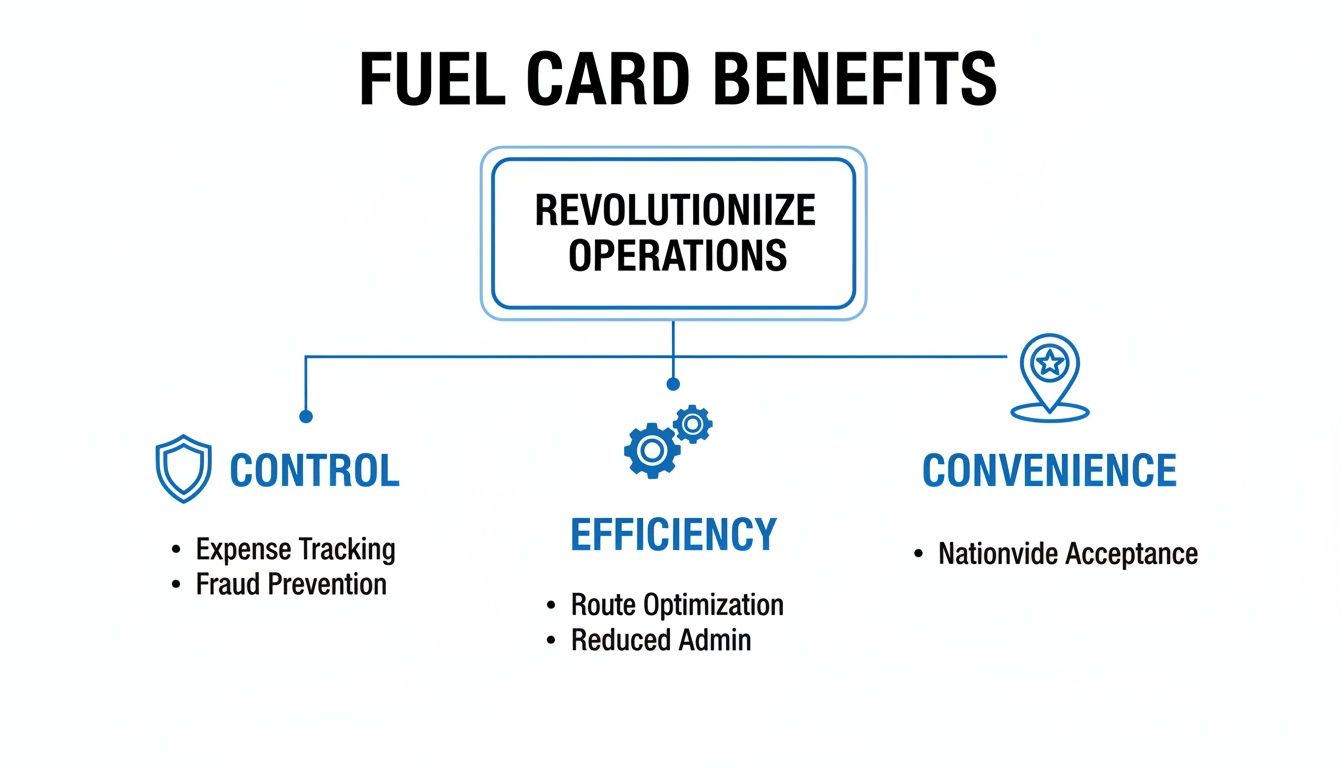
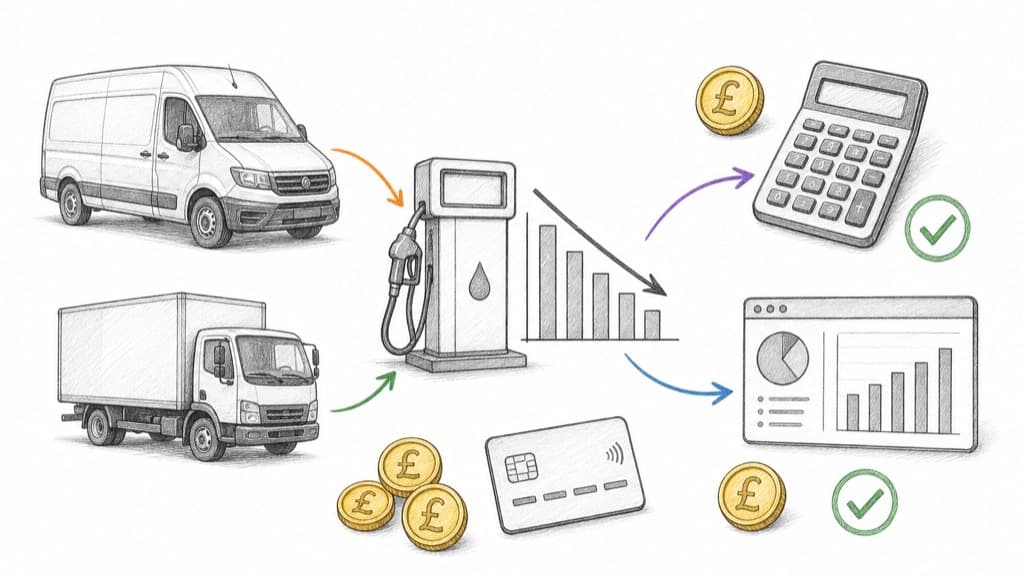
The infographic below shows how a modern fuel card goes far beyond just paying for fuel. It becomes a tool that boosts control, efficiency, and convenience across your entire operation.
The gains compound when control, efficiency, and convenience sit in one system rather than three separate ones.
To help you see the differences at a glance, here’s a breakdown of how these card types stack up for fleets operating in Europe.
Comparing Fuel Card Types for European Fleets
Card type
Best for
Pros
Cons
Branded
Fleets with predictable local routes and high loyalty to one fuel brand
Deeper discounts at one brand's stations; simple loyalty schemes
Extremely limited network; can lead to wasted time and fuel searching for stations
Network
Fleets operating within a specific region or country with good network coverage
More station choices than a branded card; consolidated billing for multiple brands
Network can still be restrictive, especially across borders; inconsistent pricing
Universal
Cross-border and national fleets that need maximum flexibility and cost control
Near-universal acceptance, access to low-cost stations, and support for EV charging and other expenses
Fewer brand-specific discounts, but this is offset by overall cost savings and flexibility
Ultimately, your fleet's operational footprint and need for flexibility will point you toward the right solution.
Key Questions to Ask Before Choosing
As you weigh your options, arm yourself with these questions to cut through the marketing noise and avoid common pitfalls:
What are the real fees? Demand transparent fees. Are there hidden network charges, monthly card fees, or sneaky transaction costs that will creep onto your invoice?
Is a deposit required? Many old-school providers demand a hefty upfront deposit, which ties up your working capital. Look for modern solutions that have no need for deposits.
Does it support cross-border travel? Check for reliable cross-border support in every country your fleet touches, without awkward currency conversions or surprise restrictions.
How versatile is it? Can the card cover everything you need? A truly modern solution works for any type of expense—from fuel, tolls, and parking to office supplies—consolidating multiple tools into one.
There's no question that fuel cards are a cornerstone of modern fleet management. In the UK alone, the recent issuance of 40,400 new cards pushed the total in circulation to a staggering 3.6 million. A massive 81.2% of these are held by fleet vehicles, showing just how critical they are to the logistics and transport world.
For a company aiming to scale efficiently, a universal, VISA-backed card can provide access to lower-cost stations and consolidate approved business spending in one place. Rally is prepaid, with no refundable deposit or personal credit check. If you're running a smaller operation, our guide on the best fuel card for small business can help you compare the options.
Moving Beyond Fuel to All-in-One Expense Management
Let's be honest, the term "fuel card" doesn't really cut it anymore. What started as a simple way to pay for petrol has evolved into something much bigger: a complete, all-in-one expense management platform that can handle every cost your business runs into, whether it's on the road or in the office.
Moving from a single-purpose card to a unified system matters most for European businesses juggling many vehicle costs. One card can cover fuel, EV charging, tolls, parking, and maintenance, which brings clarity for fleets dealing with different rules and infrastructure across Europe.
It goes further when you extend it to all business spending: the same system handles office supplies, software, or travel, so it works for everyone from directors to drivers.
Consolidating Tools for Greater Efficiency
By bringing all your spending under one roof, you can ditch separate, and often pricey, expense management software. This move delivers huge efficiency gains by creating a single source of truth for every pound spent. Your finance team will thank you when they no longer have to piece together data from multiple, disconnected systems.
This integrated approach is quickly catching on. In the UK, the fuel card market's value is expected to jump from $374.3 Million to $574 Million by 2035. This growth is being fuelled by the obvious financial and operational perks of centralised expense control, a trend that’s picking up speed as more businesses wake up to the power of a single platform.
The core benefit is simplification. Instead of juggling fuel cards, corporate credit cards, and petty cash, you have one streamlined system that is also cheaper. This cuts administrative work by over 10 hours per month and provides a clear, real-time view of your company's financial health.
Making this level of centralisation work smoothly relies on one critical piece of the puzzle. The payment layer, controls, receipt capture, and accounting sync all need to work together in one operating model for the system to stay reliable at scale.
Connecting to Your Accounting Software
The last piece is downloading the expense files your accountant needs. Once exported, transactions are matched and VAT-ready — no invoice chasing and no manual data entry.
This helps businesses of any size. Receipt capture runs through WhatsApp with no app to download, and a unified system delivers:
No separate expense management tool: Slash software costs and complexity.
One place for all invoices: Finally end the chaotic paper chase.
Simplified reconciliation: Cut down on the month-end admin grind.
Downloadable accounting exports: Keep your financial records accurate and always up to date.
By adopting an all-in-one platform, you aren’t just getting a better fuel card. You’re investing in a more efficient, controlled, and scalable way to run your entire business. To dive deeper, check out our guide on the benefits of modern company expense cards.
Fuel Card FAQs
The questions fleet and finance managers across Europe ask most often, answered directly.
"Are Fuel Cards Really Worth It for a Small Business?"
Absolutely. While the savings for a massive fleet are obviously huge, small businesses gain something just as valuable: time and control. For a small team where every hour counts, just think of the administrative headache you’ll save by ditching manual receipt chasing.
Modern fuel cards built for small businesses aren't like the old, clunky systems. They typically offer:
No minimum fleet size: You can get started with just one vehicle and still see the benefits.
Transparent fees: Costs are clear and predictable, which helps massively with budgeting and avoids nasty surprises.
No deposit requirements: This frees up precious working capital that smaller businesses need to invest in growth.
Putting a fuel card in place means you can professionalise your expense management right from the start. You gain serious control over what is often your second-biggest cost, all without a hefty upfront investment.
"How Secure Are These Cards Against Fraud and Misuse?"
Far more secure than cash or a standard company credit card. The real power of a modern fuel card is the detailed layer of control it gives you. Instead of discovering misuse weeks after the fact, you can set precise rules that prevent it from happening in the first place.
One of the biggest security wins is the ability to instantly freeze a card right from your dashboard or a mobile app. If a card is lost, stolen, or you suspect something’s off, you can shut it down in seconds. Your funds are protected immediately.
Advanced systems give you a whole toolkit of security measures, including:
Custom spending limits: Cap spending per day, per week, or even per transaction for each driver.
Purchase restrictions: Lock cards down to fuel-only purchases or other approved categories like vehicle maintenance.
Real-time alerts: Get instant notifications for anything suspicious, like someone trying to use a card after hours.
PIN protection: Every single transaction requires a unique Driver ID or PIN, adding that crucial layer of verification.
All these features work together to create a secure payment system, giving you peace of mind that company money is being spent exactly as intended.
"How Do Fuel Cards Handle Electric and Hybrid Fleets?"
Modern fleet cards assume a mix of petrol, diesel, and electric vehicles. The best ones bring fuel and EV charging costs into one platform.
Because cards backed by major networks like VISA are not tied to petrol brands and reach 99% acceptance across Europe, drivers use the same card at thousands of EV charging points as easily as at a fuel pump.
The system then pulls petrol, diesel, and electricity spend into one dashboard and VAT summary. That single view of total energy use also makes sustainability reporting straightforward: carbon tracking and environmental targets are easier when the data sits in one place.
"Is It a Hassle to Implement a Fuel Card System?"
Not anymore. The days of complicated, lengthy setups are long gone. With a modern provider, the onboarding process is designed to be fast, digital, and intuitive, getting your team up and running with minimal disruption.
It's usually a pretty straightforward process:
Digital Onboarding: You sign up online and can order physical or virtual cards through a simple dashboard in minutes.
Assign and Control: Link cards to specific drivers or vehicles and set up your custom spending rules right away.
Minimal Driver Training: With user-friendly tools like receipt capture through WhatsApp, drivers can adopt the new system without needing long training sessions.
Accounting export: A downloadable accounting export prepares the fuel-card data as a file your accountant can import, so data posts without manual re-keying.
The entire experience is designed for a smooth transition, letting your team start enjoying the benefits of automated expenses, better control, and huge time savings almost right away.
Ready to gain total control over your fleet's expenses and save hours of administrative work every month? Rally offers a VISA-backed, all-in-one platform with 99% acceptance across Europe, transparent pricing, and powerful, easy-to-use controls.
Discover how Rally can modernise your fleet management today.
Want to see how the main European providers stack up side by side? Our fuel card comparison rates the main options on pricing, network coverage and fees, all in one table.