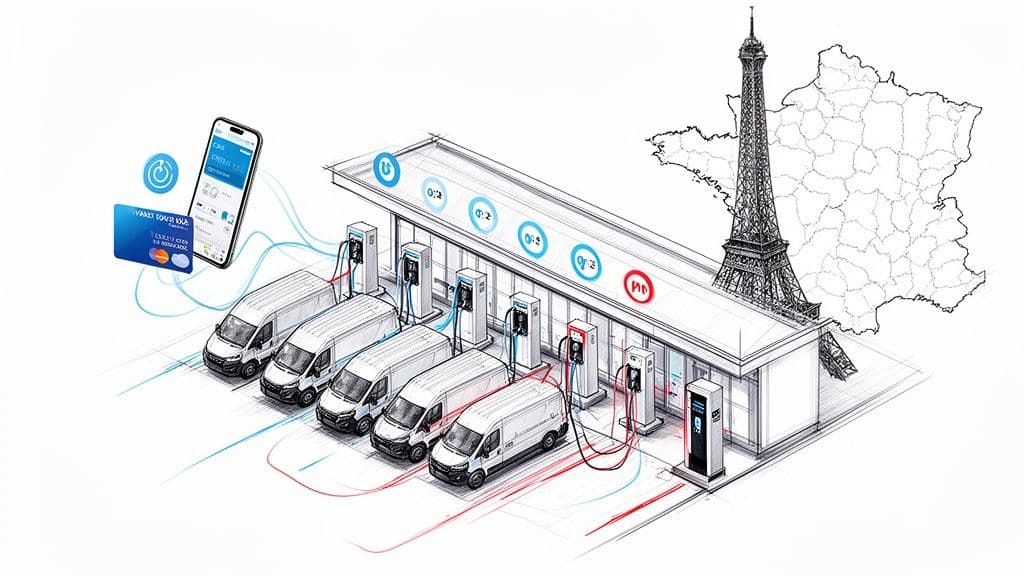
For any fleet running routes through Europe, the complex and expensive map of France toll roads is a major operational hurdle. Let's be honest, the French autoroute network is a bit of a paradox: it's the fastest, most efficient way to get goods across the country, but it comes at a steep price that eats directly into your bottom line.
Why Mastering the Map of France Toll Roads Is Critical for Your Fleet
For UK and European fleet managers, the French motorway system isn’t just another line item; it's a significant source of both operational costs and administrative headaches. Given the sheer scale and expense of this network, simply trying to avoid it isn't a realistic option for any serious logistics or transport business.
Getting a handle on these costs isn’t just a "nice-to-have" anymore. It's an absolute must for running a profitable operation in the competitive European market.
The financial hit can be substantial. For fleet managers, one stark reality hits hard: French motorways are Europe's priciest for HGVs. A single trip for one truck on the A6/A7 route from Paris to Marseille can set a driver back the equivalent of £200.68. That one journey says it all, explaining why nearly the entire French motorway network—over 8,000 km of autoroutes—is tolled.
The Hidden Costs Beyond the Tolls
The challenge goes way beyond just the fee at the barrier. Sticking to traditional payment methods creates a domino effect of problems that ripple through your back office, a key issue for fleets operating across Europe.
- The Receipt Chase: Wasting hours every month hunting down drivers for paper receipts and manually plugging that data into spreadsheets. Sound familiar?
- The Black Hole of Spending: Without a single, clear system, it’s nearly impossible to track spending in real-time. This leads to nasty budget surprises at the end of the month.
- Cross-Border Chaos: As soon as your trucks leave France, you need a different toll tag, another currency, and a separate system. It's a logistical nightmare that slows you down.
Of course, tackling tolls is just one piece of the puzzle. Optimising your entire operation benefits from a holistic approach to modern fleet management for businesses.
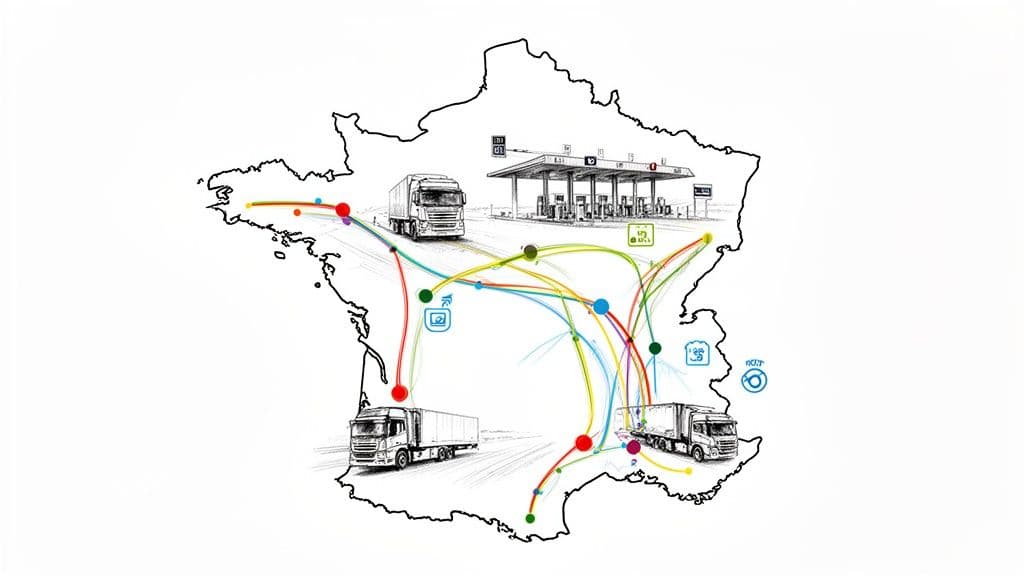
The map below gives you a sense of just how sprawling and complex the network really is.
Every blue line on that map represents a potential expense, another receipt to process, and one more data point to reconcile. This is exactly where a smarter, more integrated solution becomes essential.
By pulling all your expenses—from tolls and fuel to parking and maintenance—onto a single, VISA-backed platform, you can cut over 10 hours of manual admin work every single month. This unified approach is the very heart of effective European fleet expense management.
Getting to Grips with the French Péage System
To get a handle on your fleet's expenses as you navigate the map of France toll roads, you first have to understand the system itself. The French péage isn’t a one-size-fits-all model; it’s a complex structure where costs are directly tied to the specific type of vehicle you’re running. Getting the rules wrong is a common pitfall that can lead to some seriously nasty surprises on your monthly invoices.
At its core, the system is designed to charge vehicles based on their potential wear and tear on the road. This means things like height, gross vehicle weight, and the number of axles are all crunched to categorise your fleet and work out the final bill. Misjudge this at the planning stage, and you'll find your cost forecasting is miles off.
The flowchart below shows just how central—and often how costly—French tolls can be to your overall fleet operations.
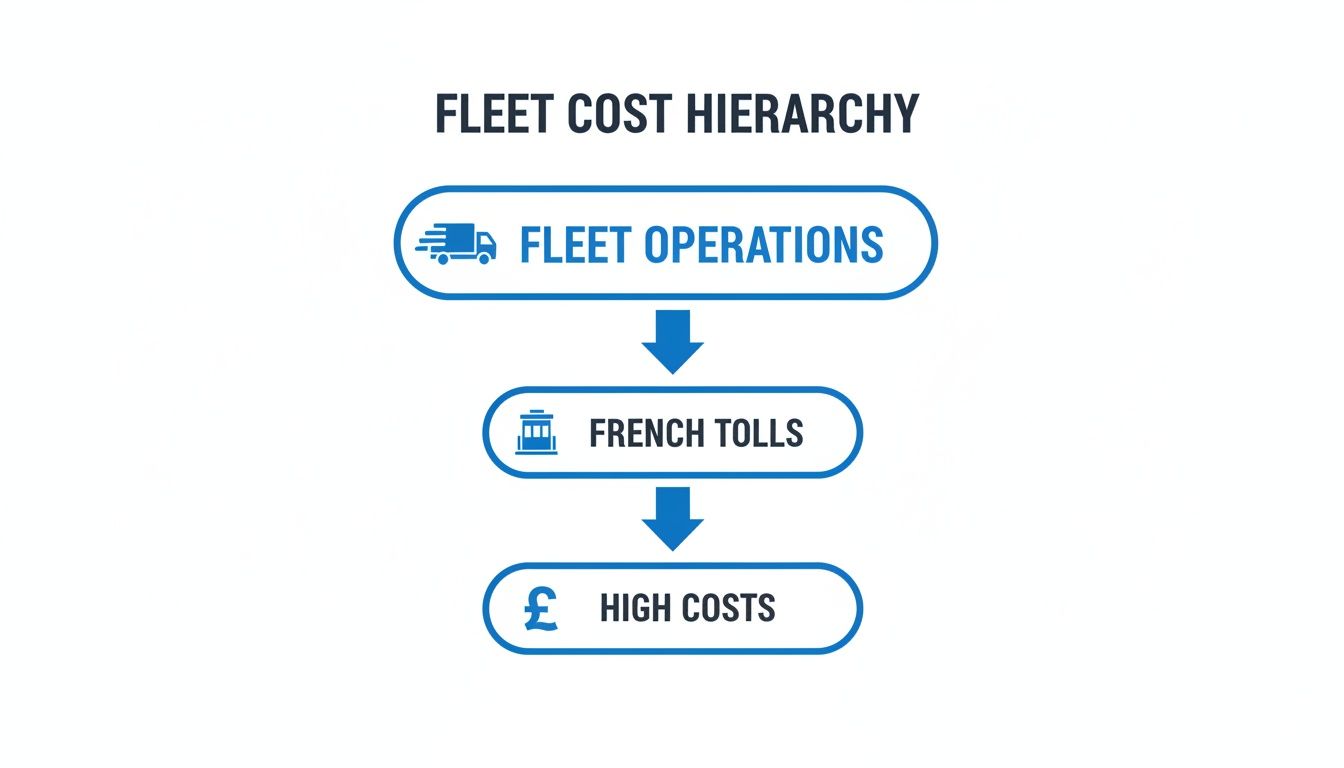
Without tight management, these toll expenses can quickly spiral, eating directly into your profitability on every single cross-border run.
Understanding Vehicle Classifications
The official classification system is the bedrock of French toll pricing. For any commercial fleet, the categories you really need to care about are Classes 2, 3, and 4. Just a small difference in a vehicle's height or axle count can bump it into a more expensive class, sending costs soaring over a long journey.
The table below breaks down the main vehicle classes for commercial transport. This is essential information for anyone trying to accurately forecast their fleet's spending on French autoroutes.
French Toll Road Vehicle Classifications
| Vehicle Class | Description | Typical Vehicle Example |
|---|---|---|
| Class 2 | Vehicles with a total height between 2 and 3 metres and a gross vehicle weight of 3.5 tonnes or less. | Most light commercial vehicles (LCVs), such as a Ford Transit or Mercedes Sprinter van. |
| Class 3 | Heavier vehicles with two axles, defined as having a total height of 3 metres or more or a gross vehicle weight exceeding 3.5 tonnes. | A standard rigid HGV or a larger box truck. |
| Class 4 | The largest vehicles—HGVs with three or more axles. These face the highest toll charges. | An articulated lorry, a tractor-trailer combination, or a coach. |
As you can see, a Class 4 HGV is going to pay a whole lot more than a Class 2 van on the exact same route. This is precisely why getting your vehicle classifications right from the start is the first step toward getting your costs under control.
Closed vs Open Toll Systems
It's not just about the vehicle. The autoroutes themselves use two completely different billing setups. Knowing how both work is key to avoiding confusion at the toll plaza and making sure your drivers know what to do.
The most common setup is the 'closed system' (système fermé). Here, a driver grabs a ticket when they get on the motorway and pays when they get off. The final charge is calculated based on the distance they've driven, multiplied by their vehicle's class rate.
You’ll find this system on most of the long-distance motorways.
But you'll also run into the 'open system' (système ouvert). On these stretches, often near big cities or on certain sections of motorway, drivers pay a fixed flat fee at a single toll booth. No ticket, no fuss—you just pay to pass that point.
Understanding these two systems is fundamental for any fleet manager. It helps with forecasting costs and also preps your drivers for what to expect, cutting down on delays and payment mix-ups. But let's be honest, managing all these different costs, classifications, and payment types across an entire fleet creates a huge administrative headache. A unified payment solution, like a single VISA-backed card that works seamlessly across both systems, gets rid of the need for drivers to juggle multiple payment methods or for your finance team to reconcile a mess of different transaction formats. It simplifies the whole process, giving you a clear, transparent picture of your spending, no matter which road you're on.
Time to Modernise: Moving Beyond Old-School Toll Payments
For any fleet manager navigating the complex map of France toll roads, the old ways of paying are becoming a serious drag on business. Juggling cash floats, sorting through individual driver credit card slips, or managing a baffling collection of toll tags for different regions just creates friction. It’s an administrative nightmare.
The whole system is messy and wasn't built for the fast pace of modern commercial transport. You’ve got drivers stuck in long queues at the plazas, the constant headache of lost paper receipts, and the painful, time-sucking chore of reconciling it all at the end of the month. Each little delay adds up, costing you valuable time on the road and burying your finance team in manual work.
The Problem with Patchwork Payments
The real issue boils down to one thing: a total lack of centralisation. When drivers are paying with cash or their own cards, you have zero real-time visibility into what’s being spent. It's a data black hole until the receipts eventually trickle in—often weeks later—making any kind of on-the-spot budget control a fantasy.
- Manual Reconciliation: This is the big one. Someone has to physically collect, sort, and type up data from hundreds of tiny, faded paper slips every single month.
- No Real Control: Without a single system, it's incredibly difficult to enforce spending rules or even track costs against a specific lorry or job.
- Cross-Border Chaos: As soon as your fleet crosses into another European country, the complexity multiplies. You might need a different toll tag, a separate account, or have to deal with foreign currency transactions. It's just another layer of hassle.
This outdated approach isn't just inefficient; it's genuinely expensive. Transport companies already face some of the steepest operating costs in Europe, particularly on the vital UK-France corridors. Just look at the Eurotunnel from Folkestone to Calais—it's Europe's priciest toll and a critical artery for over 1.5 million trucks a year.
Then there’s France itself, often called the "toll fee capital" of Europe. A single run from Paris down to Marseille can cost nearly €69, showing just how heavy the financial burden is. It’s clear that sticking with the old way is costing fleets dearly.
A Unified Solution for Today's Fleets
It’s time for an upgrade. Imagine swapping that entire mess of cash, cards, and tags for a single, smart payment tool. A modern, VISA-backed card offers a much cleaner alternative, one that’s been designed from the ground up to solve the exact problems commercial fleets face.
Rally reports a 99% Visa acceptance rate across eligible merchants, giving drivers another payment option at many toll plazas across France and Europe. It can reduce the need for cash or multiple payment accounts while bringing card transactions into one system.
The real power is in consolidation. When you bring all your on-the-road expenses—tolls, fuel, parking, even EV charging—onto one platform, you transform an administrative monster into a simple, automated workflow.
Rally discloses its fees clearly, and every payment is tracked in real time for dashboard-level visibility. Its prepaid option requires no refundable security deposit or personal credit check, but business and representative verification still applies. Postpaid terms require separate approval and may involve credit or security requirements.
More Than Just a Payment Card
This modern approach is about much more than just paying for a toll. It bundles multiple tools into one, making it a cheaper and more effective solution for your entire operation.
- Cross-Border Simplicity: One card works in any country, removing the headaches of international journeys.
- Total Expense Management: It’s not just for tolls. Use it for any business expense, from office supplies to emergency vehicle maintenance.
- Streamlined Workflows: You no longer need a separate expense management tool. Everything from payment to reconciliation happens in one place.
- Built for Everyone: The system is designed to be intuitive for everyone, from directors to drivers.
- No More Chasing Invoices: All receipts and transaction data are captured and stored in one place, with direct accounting integration.
- WhatsApp Receipt Capture: Drivers can just snap a picture of a receipt and send it via WhatsApp. No need to download and learn yet another app.
Ultimately, this kind of integrated system can cut over 10 hours of manual work per month. It's a strategic shift that moves your team away from tedious admin and towards smarter, data-driven decisions. And when you combine this payment data with insights from your fuel card services, you get a complete picture of your journey costs, allowing for true optimisation of your fleet's financial health.
Smarter Route Planning to Reduce Total Journey Costs
Anyone managing a fleet across the map of France toll roads knows it’s about more than just dodging the most expensive péages. The real game is nailing the lowest total journey cost. A route with zero tolls might look great on paper, but if it adds hours to the clock, guzzles fuel on stop-start local roads, and pushes your drivers over their legal hours, it’s a classic false economy. The goal is to strike the perfect balance between speed, cost, and efficiency for every single trip.
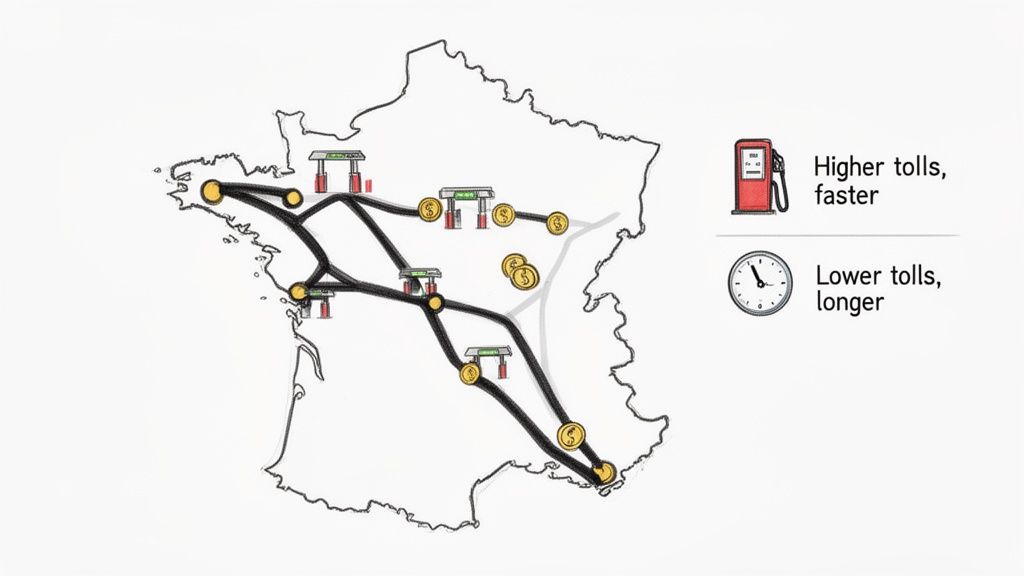
This means running a proper cost-benefit analysis. For time-sensitive deliveries, a direct, toll-heavy autoroute journey is often a no-brainer. But for less urgent shipments where every penny on fuel counts, a detour onto the national roads (Routes Nationales) could be the smarter play.
The True Cost of a Journey
To make the right call, fleet managers have to weigh up several competing factors. The problem for most businesses is that the data needed to do this is scattered everywhere—a fuel card account here, a separate toll tag system there, and a pile of manual expense receipts somewhere in between.
The total cost equation is a mix of:
- Toll Fees: The obvious one, based on distance and vehicle class.
- Fuel Consumption: Slow, stop-start driving on B-roads can burn more fuel than cruising at a steady speed on the motorway, wiping out any toll savings.
- Driver Hours: Longer routes mean higher wage costs and headaches with working time directives. An extra two hours on the road could force a driver into a mandatory rest period, causing serious delays.
- Vehicle Wear and Tear: The smooth tarmac of the autoroutes is a lot kinder to your vehicles than poorly maintained back roads.
- Delivery Deadlines: For any logistics operation, missing a delivery window can trigger penalties that make any toll savings look tiny.
This balancing act is only getting tougher. As fleet operators navigate France's toll road map, they’re watching prices climb. A 2.7% average increase has been confirmed for 2024, continuing a multi-year trend. With France's autoroutes being almost entirely tolled, these hikes hit HGVs particularly hard, making smart cost control essential. You can read the full research on recent toll increases in France.
An Integrated Approach to Route Optimisation
This is where having a unified expense platform changes everything. It transforms route planning from guesswork into a data-driven strategy. When all your journey costs—tolls, fuel, parking, maintenance—are captured on a single VISA-backed card and pop up on one dashboard, you can finally see the full picture and run a true cost analysis for every route.
By pulling all your expenses together, you can accurately compare the total cost of Route A versus Route B. You might discover that paying a €60 toll on the autoroute is actually 15% cheaper overall once you factor in the lower fuel burn and driver time.
This integrated view empowers managers to make better decisions, fast. With access to a network of low-cost fuel stations, you can even direct drivers to refuel strategically, shaving even more off the total journey cost. A platform like Rally provides this consolidated view, turning a mess of complex variables into a clear financial picture.
Practical Benefits for European Fleets
A unified platform offers more than just tidy data; it delivers real-world advantages that solve the key problems fleets face every day.
- Cheaper Operations: With access to the lowest fuel prices in Europe and transparent fees, you can actively cut your two biggest variable costs.
- Prepaid Without a Refundable Security Deposit: Rally's prepaid option also requires no personal credit check, but business and representative verification still applies. Postpaid terms require separate approval and may involve credit or security requirements.
- Cross-Border Simplicity: One card works seamlessly in any country, getting rid of the hassle of managing multiple payment systems for international jobs.
- Consolidated Power: It combines payments, expense management, and accounting integration into a single, cheaper tool, saving you money on software subscriptions.
Ultimately, mastering the map of France toll roads isn’t about avoiding tolls at all costs. It's about having the right data and tools to choose the most cost-effective route, every single time, ensuring your fleet runs as efficiently and profitably as possible.
How to Automate Toll Expense Management and Save Hours of Work
Getting your head around the map of France toll roads is one thing, but for any fleet operating across Europe, the real headache is the mountain of paperwork that follows. Finance teams know the drill: they’re buried under a blizzard of paper receipts, wrestling with currency conversions, and losing hours to manual data entry. This isn't just a drag; it's a direct hit to your bottom line.
The typical workflow is stuck in the past. Drivers juggle dozens of flimsy toll slips, which inevitably get lost or turned in weeks late. From there, a finance manager has to manually decode, sort, and match every single one against bank or card statements. It’s slow, full of errors, and gives you absolutely zero real-time visibility into what your fleet is actually spending. It’s an admin nightmare that costs businesses a fortune.
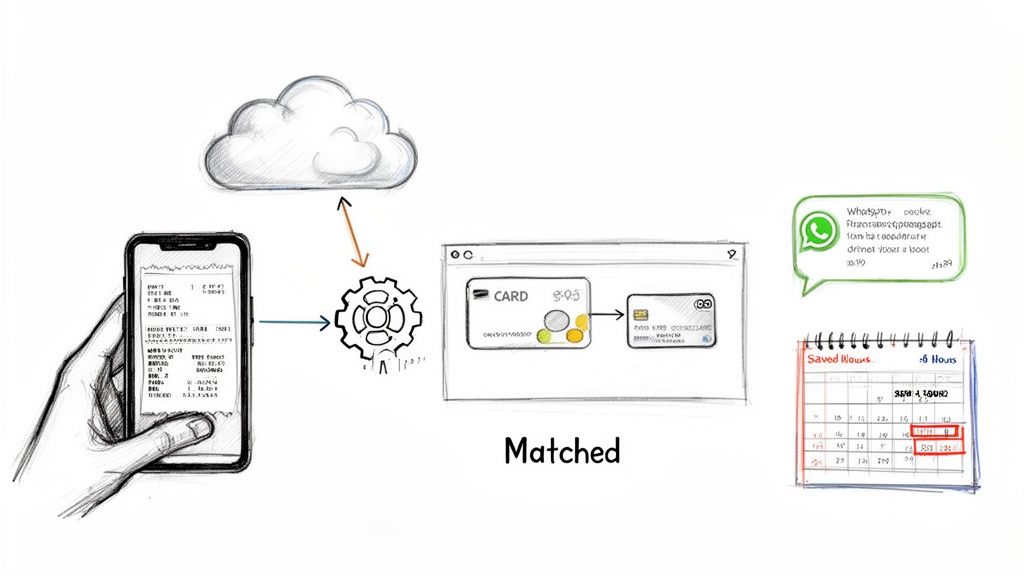
This administrative grind is a huge problem for fleets crisscrossing Europe, where different currencies and languages just add more layers of complexity. The constant chase for missing invoices and the hours wasted on mind-numbing manual work are pain points that modern businesses simply can't afford anymore.
From Paper Chaos to Automated Clarity
Now, picture a different way. A driver pays a toll, snaps a quick photo of the receipt, and pings it over via WhatsApp. In that instant, smart tech reads the receipt, matches it to the right card transaction, and logs the expense without anyone having to lift a finger.
This is how you solve the toll expense headache for good. By ditching the manual grind for an automated system, you can cut over 10 hours of manual work every single month. That frees up your finance team to do what they do best: analyse spending, not just type it in.
The real magic is in the consolidation. When you bring every single fleet expense—tolls, fuel, parking, EV charging, and even day-to-day business costs—into one dashboard, you kill the need for separate expense tools. You finally put an end to the endless invoice chase.
This streamlined approach gives you a clear, real-time view of your spending, turning budget management from a reactive chore into a proactive strategy. It simplifies life for everyone, from directors needing a financial overview to drivers out on the road.
A Single Tool for Total Fleet Control
A modern, integrated platform does a lot more than just process receipts. It becomes the financial engine of your entire fleet operation, offering powerful perks that tackle the big challenges of the European market head-on. And by consolidating multiple tools into one, it also ends up being a cheaper, more efficient solution.
Here’s how a unified system can completely change the game for fleet expense management:
- One Card for Approved Expenses: A Visa-backed card for tolls, parking, fuel and other permitted business costs. Rally reports 99% Visa acceptance across eligible merchants; acceptance still depends on the merchant and transaction type.
- Lower-Cost Fuel Options: An integrated system can give you access to low-cost fuel stations, helping reduce one of your biggest running costs.
- Prepaid Without a Refundable Security Deposit: No personal credit check is required, but business and representative verification still applies. Postpaid terms require separate approval and may involve credit or security requirements.
- Transparent Fees: Say goodbye to hidden charges and nasty surprises. A modern platform gives you clear, upfront fees, so you always know exactly what you’re paying.
- Seamless Accounting Integration: All your expense data syncs straight into your accounting software, making month-end closing faster and more accurate than ever. You can learn more about how a single card can handle fleet expenses in our guide on why modern fleet cards beat traditional fuel cards.
This level of automation and control isn't a luxury anymore—it’s essential for any fleet that wants to stay competitive. By eliminating the manual grind of expense management, you can unlock serious savings and make your entire business run more efficiently.
Got Questions About French Toll Roads? We've Got Answers.
Running a fleet across France means dealing with the autoroute network, and that always brings up questions. Here are some straightforward answers to the common queries we hear from fleet managers and drivers, designed to clear things up and help you run a tighter ship.
Can I Really Use Just One Payment Method for All Tolls in France?
Technically, most French Télépéage tags work across the country, but the moment your trucks cross a border, things get complicated. Suddenly you're juggling different tags for different countries, which is a real headache.
A single, unified solution like a VISA-backed Rally card changes the workflow. Rally reports 99% Visa acceptance across eligible merchants, but acceptance at a specific French toll plaza or for a specific transaction depends on the operator and terminal. The card also works at eligible merchants in other European countries. Rally's prepaid option requires no refundable security deposit or personal credit check, but business and representative verification still applies. Postpaid terms require separate approval and may involve credit or security requirements.
What Happens if One of Our HGVs Ends Up in the Wrong Toll Lane?
It's a classic scenario: an HGV driver accidentally enters a car-only lane, often marked 'VL' or with a <2m height restriction. It’s a simple mistake that can throw a tight schedule into chaos.
The driver usually has to hit the assistance button, which kicks off a manual payment process and often causes a frustrating traffic jam behind them. The easiest way to sidestep these costly delays is to use a universally accepted payment card in the designated HGV or "toutes classes" (all vehicles) lanes.
How Can I Budget for Toll Costs on a New Route Accurately?
Online toll calculators give you a ballpark figure, but they often miss real-time variables and, more importantly, they don’t show you the total journey cost. A genuinely accurate budget needs a much bigger picture.
This is where a comprehensive platform like Rally comes in. It lets you dive into your own historical spending data on similar routes.
By pulling tolls, low-cost fuel options, and other key expenses onto a single dashboard, you can build a forecast that reflects your true operational costs, not just the toll fees. This kind of data-driven planning is what separates profitable routes from costly ones.
Better yet, this consolidation means you can cut over 10 hours of manual admin work each month, because the data is already there—no more wrestling with spreadsheets.
Are There Penalties for Not Paying a Toll in France?
Yes, and they can sting. If a payment fails and a vehicle drives through the barrier anyway, cameras will snap the licence plate. The toll operator then issues a fine, which is typically the maximum toll for that route plus a hefty administrative fee.
Don't assume you can ignore it if your fleet is foreign-registered. These fines are pursued across borders, so there's no getting away with it. A reliable payment system with high acceptance and a clear view of your balance is your best defence against declined payments and expensive penalties.
How Can Our Fleet Cut Down on Overall Toll and Fuel Spending?
Smart spending isn't just about tolls; it also means comparing fuel costs. A consolidated payment platform can give drivers access to low-cost fuel stations and help them choose a lower-priced practical option on each route.
On top of that, transparent fees help with budgeting. Rally's prepaid option requires no refundable security deposit or personal credit check, which can keep cash available to the business, but business and representative verification still applies. Postpaid terms require separate approval and may involve credit or security requirements. Bringing payment, expense management, and accounting together can cost less than juggling multiple services.
Managing fleet expenses across France and Europe doesn't have to be a mess of paperwork and manual tracking. Rally provides a single, VISA-backed card and an all-in-one platform to automate your toll, fuel, and expense management, saving you time and money on every single journey.