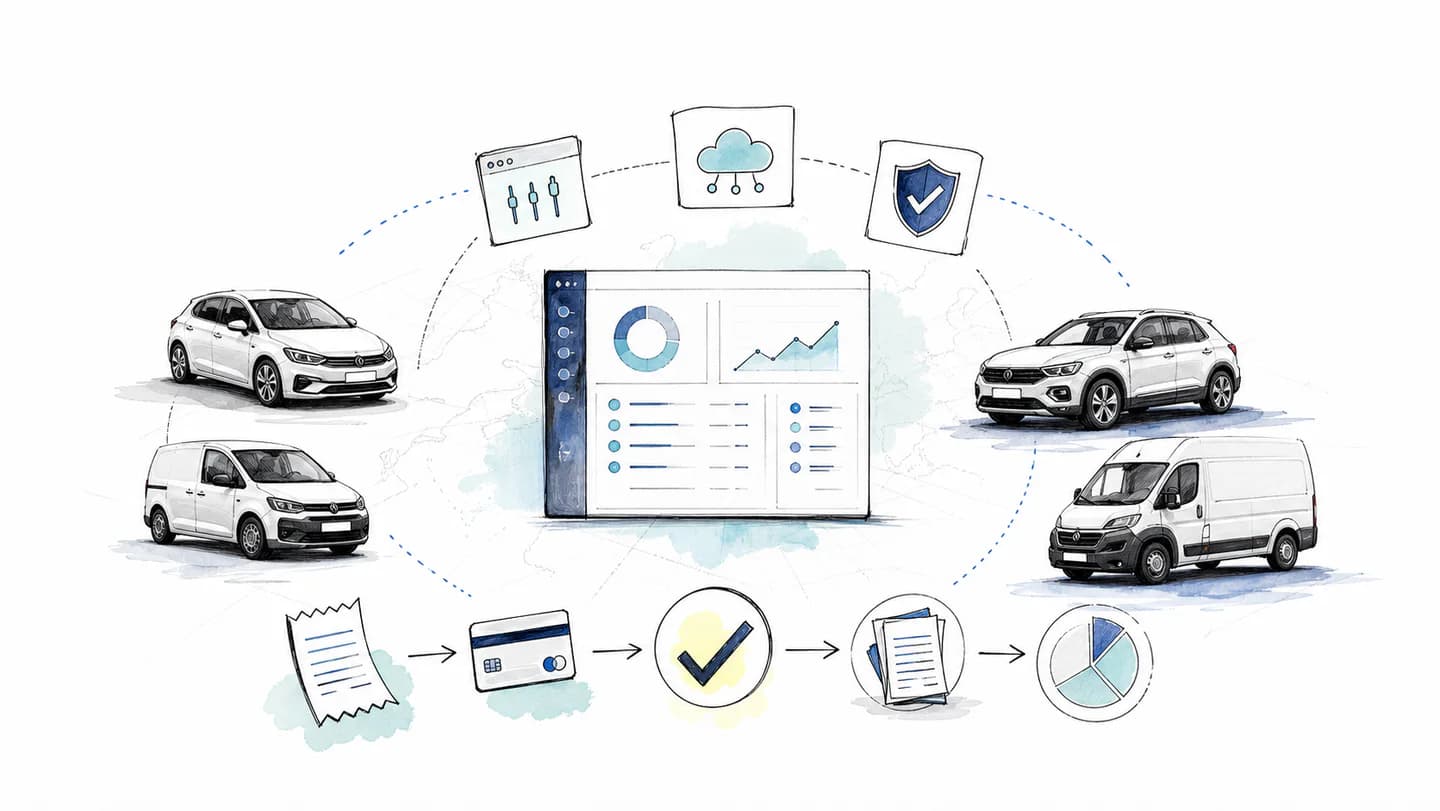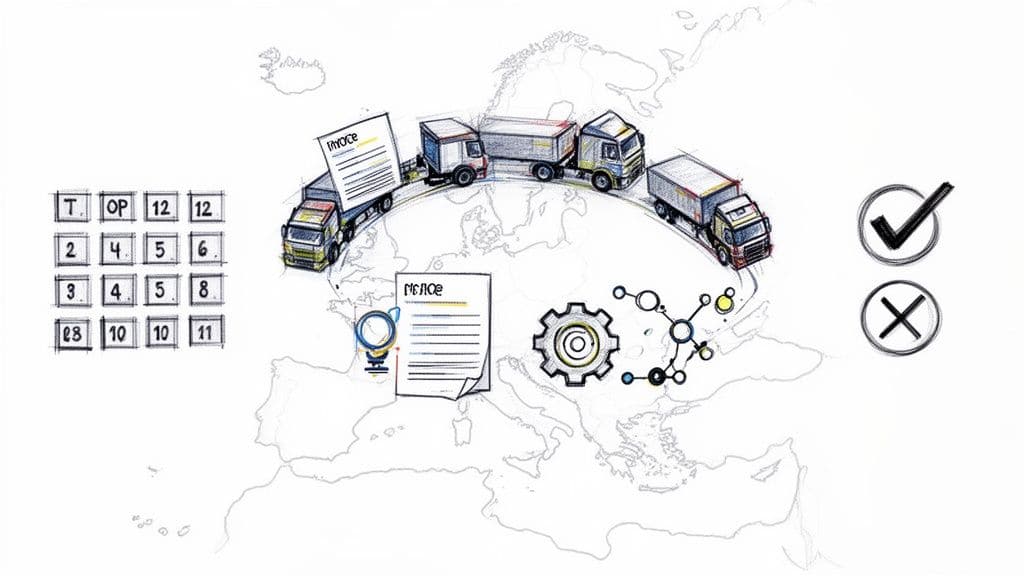
Managing a European fleet means dealing with a constant stream of invoices from countless sources. Fuel in France, tolls in Germany, parking in London, and EV charging in the Netherlands all generate separate receipts and invoices. Finance teams can lose hours every month chasing drivers for lost paper slips, entering data by hand and untangling cross-border VAT. That administrative burden is not just frustrating; it is expensive.
This fragmented system makes it nearly impossible to get a clear, real-time view of your fleet's spending. Key problems include a lack of control over expenditure, missed savings at low-cost fuel stations, and the complexity of managing both traditional fuel and EV charging. These inefficiencies directly impact your bottom line and prevent your team from focusing on strategic growth. It is also why so many finance teams are now looking at AI-assisted finance tooling, of which automated invoice processing software is usually the first serious step.
This article cuts through the noise. Instead of ranking products, it breaks the market into the five categories of automated invoice processing software a European fleet will realistically shortlist, explains how each category actually works under the bonnet, and sets out where each one tends to fall short once vehicles cross a border. Use it to work out which category you are buying from before you sit through a single demo, because the biggest procurement mistakes in this market are category mistakes, not product mistakes.
What Automated Invoice Processing Software Actually Does
Every product in this market automates some subset of the same seven-stage pipeline. Knowing which stages a category covers is the fastest way to tell whether a shortlist is comparing like with like.
- Capture. Getting the document into the system: email forwarding, a supplier portal, a scanning app, an e-invoicing network feed, or a card transaction that never produces a paper document at all.
- Extraction. Reading the header and line-item data off the document — supplier, date, net, VAT rate, VAT amount, currency, invoice number, PO reference, item codes.
- Validation. Checking that the extracted data is internally consistent and legally sufficient: is the VAT arithmetic right, is the supplier VAT number valid, is this a duplicate of something already posted.
- Matching. Comparing the invoice against a purchase order, a goods received note, a contract, or a card transaction so you only pay for what you actually ordered and received.
- Approval. Routing to the right budget holder, with a defensible audit trail of who approved what and when.
- Posting. Writing the coded transaction into your ERP or accounting system against the correct cost centre, vehicle, or project.
- Payment and archive. Settling the invoice and keeping a compliant record for the retention period your tax authorities require.
A fleet's problem is that stages one to three are where almost all the pain lives, and the documents causing that pain are not supplier invoices at all. A toll gantry charge, a two-euro parking ticket, and a rapid-charge session receipt are tiny, high-volume, and generated on the road by someone who is not in finance. Software designed around a monthly stack of supplier bills handles them badly, no matter how good its extraction engine is.
How To Judge A Category Before You Judge A Product
Five questions separate the categories cleanly. Ask them first, and the shortlist writes itself.
- Where does the data originate? At the point of payment, or on a piece of paper someone has to photograph later? Capturing at source removes the document entirely; everything else is document recovery.
- How many stages does it cover? Some categories are complete pipelines. Others are excellent at one stage and assume you already own the rest.
- What is the unit of pricing? Per document, per user, per transaction volume, or bundled into a subscription you already pay for. This determines whether high-volume, low-value fleet receipts are cheap or ruinous.
- How does it treat cross-border VAT? Reclaiming foreign VAT needs a compliant original document with the correct VAT breakdown, not just a scanned total.
- What does implementation actually cost? Not the licence: the weeks of workflow configuration, integration work, and supplier onboarding that make the licence useful.
Category 1: Fleet-Native Spend Platforms That Capture The Invoice At Source
This is the newest category and the one Rally sits in. Rather than processing an invoice after the fact, these platforms issue payment instruments — typically Visa or Mastercard cards, physical and virtual — and capture the transaction data at the moment of purchase. The card transaction is the record. Receipt capture becomes a supporting document attached to a transaction that is already coded, dated, and reconciled, rather than the raw material finance has to work from.
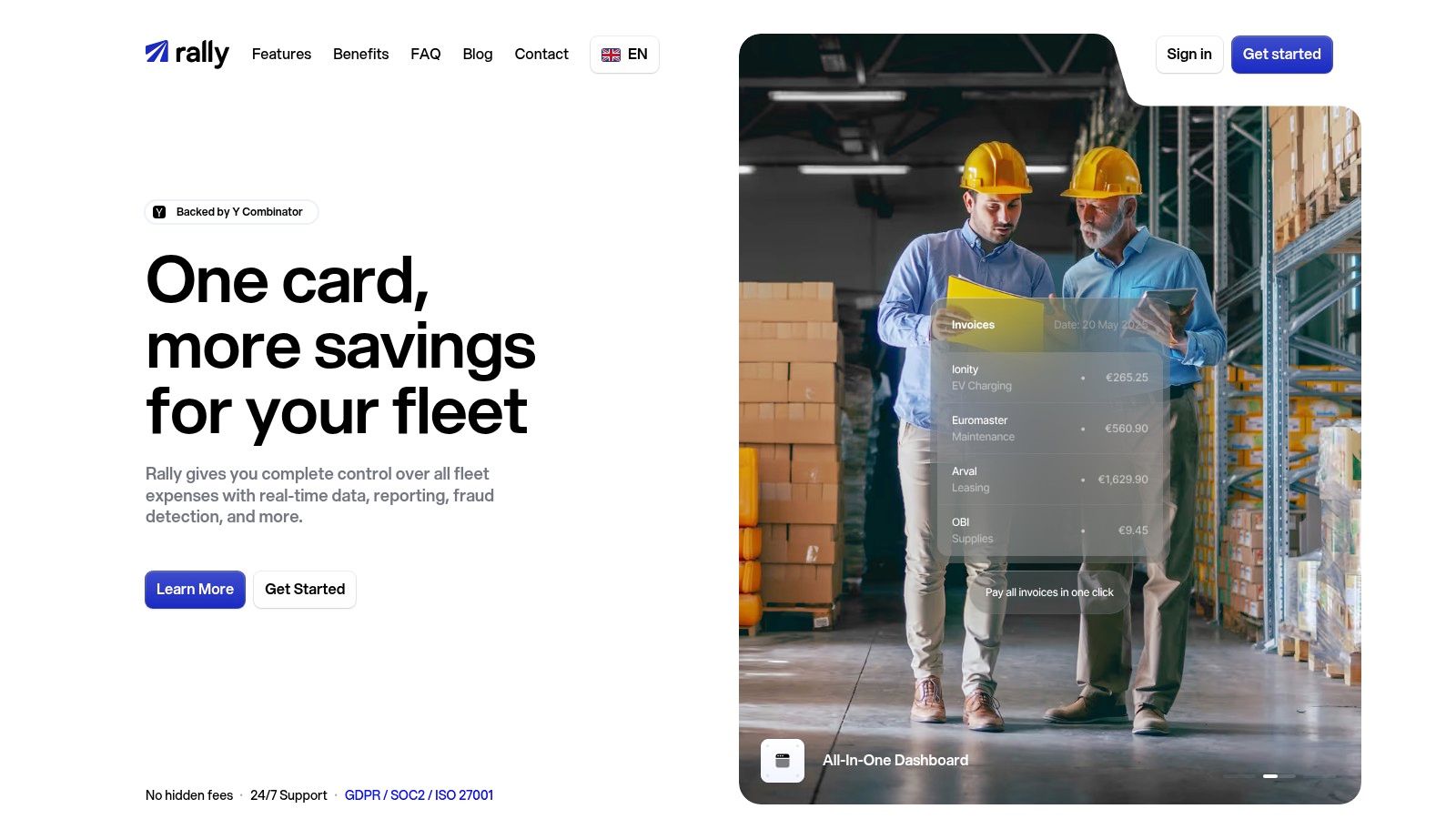
Because the platform sees the transaction in real time, spend controls run before the money moves rather than after. You can cap a category, restrict a merchant type, set per-driver and per-vehicle limits, and block out-of-policy spend at the terminal. The reconciliation problem that dominates the other four categories largely disappears: there is no month-end pile of unmatched documents, because each line already has a payer, a vehicle, a cost centre, and a timestamp attached to it.
Rally applies this model to the specific mix a European fleet generates — fuel, tolls, parking, maintenance, and general business expenses on one Visa-backed card with 99% acceptance. Drivers submit receipts through WhatsApp, which matters more than it sounds: it removes app downloads, logins, and training from the single group of people least likely to tolerate any of them. Rally's AI captures the data, categorises the expense, matches it to the transaction, and prepares downloadable accounting files. In practice this removes up to 20 hours of manual work per month and pulls the month-end close forward.
Typical Capabilities
- Capture at source: the payment itself creates the structured record, so fuel, tolls, parking, and charging never enter the document backlog in the first place.
- Pre-spend controls: per-driver, per-vehicle, and per-category limits enforced at authorisation rather than discovered in a report weeks later.
- Receipt collection through channels drivers already use: messaging-based submission rather than a bespoke app, which is what makes compliance rates hold up over time.
- Cross-border coverage as standard: multi-currency transactions and pan-European acceptance.
- Spend analytics tied to assets: cost per vehicle, cost per kilometre, and fuel efficiency analysis, not just cost per supplier. Fleets using this model typically save 5-10% on fuel by routing to lower-cost stations.
Limits And Best Fit
The trade-off is scope. A fleet-native platform is built around card-settled operational spend, so it is not designed to be your general accounts payable system for large contracted supplier invoices, staged capital purchases, or complex procurement approval chains. If most of your spend arrives as monthly consolidated supplier bills with purchase order matching, that portion of the pipeline still belongs elsewhere. Coverage is also regional by design: platforms optimised for European acceptance, VAT rules, and charging networks are less useful to a business whose vehicles mostly operate outside Europe. Rally's own pricing is transparent, and it is prepaid, with no refundable deposit or personal credit check.
Best fit: operators whose invoice pain is dominated by high-volume, low-value, on-the-road transactions across multiple countries. For context on how card-based control changes the finance workflow, company expense cards covers the mechanics in more detail.
Category 2: Accounts Payable Automation Suites For Mid-Market And Enterprise Finance
This is the established heart of the market. AP automation suites take the full supplier-invoice pipeline from capture through to payment, and they are genuinely good at it. Invoices arrive by email, portal, or e-invoicing feed; machine learning extracts the data; configurable rules route the invoice to approvers; two-way and three-way matching validates it against purchase orders and goods received notes; and the coded result posts into your ERP or accounting system.
The differentiators inside this category are approval flexibility, matching depth, and how much of the work the supplier does for you. Many suites include a self-service supplier portal where vendors maintain their own bank details, tax registrations, and contact information — which sounds administrative but removes a real fraud vector and a substantial amount of chasing. Most now layer an AI assistant over general ledger coding that learns your patterns and proposes codes, with accuracy improving as it sees more of your history. Multi-entity support is standard: if you run separate legal entities per depot or per country, these suites will consolidate them into one AP workspace.
Typical Capabilities
- End-to-end coverage: capture, extraction, validation, matching, approval, posting, and payment in one system with a single audit trail.
- Multi-way matching: invoices reconciled against purchase orders and goods receipts, which is how you stop overpayment on parts and scheduled maintenance work.
- Learned coding: AI that proposes general ledger codes and approval routes based on your historical decisions.
- Supplier self-service: portals that shift onboarding, tax detail collection, and bank detail maintenance onto the supplier.
- Multi-entity and multi-currency handling: with live FX where cross-border payment is part of the workflow.
Limits And Best Fit
These suites assume an invoice exists. That assumption is fine for a tyre supplier and useless for a toll gantry. Fleets that adopt one still need a separate mechanism for driver-generated spend, and end up feeding card transaction data in from the side. Pricing is usually quote-only and scales with transaction volume or modules rather than seats, which suits a small finance team processing high volume but makes the total cost hard to predict during evaluation. Implementation is a project, not a switch: expect weeks of workflow configuration and vendor-assisted integration before the automation rate justifies the licence.
Best fit: mid-market and enterprise finance teams with genuine purchase-order discipline, multiple entities, and a supplier base large enough that portal onboarding pays for itself. Pair with something that handles per-driver spend directly — modern fuel card services consolidate that side rather than converting it into more documents to process.
Category 3: Document Capture And Data Extraction Engines
This category does one stage extremely well and deliberately leaves the rest to you. These are OCR and intelligent document processing engines: you feed them documents in any layout and they return clean, structured, validated data through an API, a webhook, or a direct mailbox connection.
The technical distinction that matters is template-less extraction. Older OCR required you to define a template per supplier layout, which collapses the moment you deal with hundreds of independent repair shops, regional toll operators, and small suppliers across several languages. Modern engines use models that infer the structure of an unseen document, including line items, without prior configuration. The good ones pair this with human-in-the-loop validation: rather than reviewing every document, an operator is shown only the specific fields the model flagged as low confidence. On a large monthly volume that difference is measured in days of work.
Typical Capabilities
- Template-less extraction: header and line-item capture from unseen layouts, across languages, without per-supplier setup.
- Confidence scoring and targeted review: operators confirm only uncertain fields instead of reading whole documents.
- Duplicate detection: flagging repeat submissions on key field combinations before they reach payment.
- Integration-first design: APIs, webhooks, and mailbox listeners intended to feed a system you already own.
- VAT-aware field capture: correct separation of net, rate, and VAT amount, which is what makes a foreign reclaim survive scrutiny.
Limits And Best Fit
An extraction engine is not automated invoice processing software on its own. It has no approval workflow, no payment rail, and no ledger, so its value depends entirely on what you connect it to and how well you connect it. That integration is a development project with ongoing maintenance. Entry pricing in this category is aimed at high-volume operations and is generally the least accessible of the five for a small fleet, because the economics only work above a substantial monthly document count.
Best fit: organisations with a large, highly varied inbound document flow and the technical resource to wire the output into an existing financial stack. If your document variety is the problem and your workflow is already fine, this is the surgical fix.
Category 4: Bookkeeping-Led Capture Tools Bundled With Accounting Software
The fourth category comprises pre-accounting capture tools, either sold as lightweight standalone products or included with an accounting subscription you already pay for. The workflow is deliberately simple: submit a document by mobile photo or a dedicated email address, the tool extracts supplier, date, total, and VAT, and it creates a draft bill in the ledger ready for review, approval, and payment.
Their advantage is proximity. Because the capture tool and the ledger are the same ecosystem, the coding, the payment, the bank reconciliation, and the VAT return all happen in one place with no integration to maintain. Supplier rules let you automate recurring categorisation, and every document is archived against its transaction, which is exactly what an auditor or a Making Tax Digital submission wants to see. For a fleet running twenty vehicles and a bookkeeper rather than a finance department, this category often delivers most of the available benefit for a fraction of the cost and effort of the others.
Typical Capabilities
- Low-friction submission: mobile photo, email forwarding, or bulk upload, with no onboarding burden on the submitter.
- VAT-aware extraction: the fields a domestic return needs, populated into a draft bill automatically.
- Supplier rules: recurring expenses coded automatically once a pattern is confirmed.
- Bundled pricing: frequently included in an accounting subscription, so marginal cost is close to zero.
- Linked archive: every source document stored against the posted transaction for audit and retention.
Limits And Best Fit
The ceiling is low by design. Approval workflows are basic — usually a single reviewer rather than conditional routing by amount, cost centre, or entity — and three-way matching against purchase orders and goods receipts is generally absent. Multi-entity and multi-currency handling is limited, which becomes a real constraint for cross-border operations. And the model still depends on someone photographing a receipt: it digitises the paper trail rather than eliminating it, so driver compliance remains the weak link. Fleets with dispersed drivers generating constant ad-hoc tolls and parking usually outgrow this category on volume long before they outgrow it on features.
Best fit: small and mid-sized operators already committed to an accounting platform, with modest invoice volume, a single entity, and mostly domestic spend.
Category 5: Global AP And Procure-To-Pay Platforms
The largest platforms treat invoice processing as one module inside a full business spend management or procure-to-pay suite that also covers sourcing, procurement, contracts, supplier risk, payments, and analytics. They are bought by organisations for which the invoice is the end of a controlled process that began with a requisition, not an unexpected document arriving in an inbox.
What justifies the weight is compliance and scale. These platforms maintain e-invoicing and tax validation rules across dozens of jurisdictions and update them centrally as regulations change — which, with mandatory e-invoicing rolling out unevenly across Europe, is a genuine and growing burden to carry in-house. They connect directly to interoperability networks such as Peppol, support national formats including XRechnung and Factur-X, and integrate with a very wide range of ERP systems, which matters when different countries in the group run different finance systems. Fraud and duplicate detection algorithms analyse spending patterns across the whole estate rather than one entity at a time, and touchless processing rates — the share of invoices that reach payment with no human intervention — are the headline metric these platforms compete on.
Typical Capabilities
- Multi-jurisdiction compliance: e-invoicing and tax rule validation maintained centrally across many countries, with network connectivity built in.
- Very broad ERP integration: support for heterogeneous, multi-system finance estates.
- High touchless rates: straight-through processing on recurring and contracted spend.
- Fraud and duplicate prevention: pattern analysis across entities to catch leakage a single-entity view would miss.
- Full procure-to-pay context: requisition, approval, contract, receipt, and invoice held as one chain of evidence.
Limits And Best Fit
Cost and time. Pricing is enterprise-level and quote-only, the buying cycle is long, and implementation is a structured programme requiring internal project resource alongside professional services. The value is also concentrated: adopt the invoice module alone and you pay for a suite while using a fraction of it. For fleet-specific questions these platforms give excellent spend visibility at the category and supplier level, but rarely the per-vehicle operational detail an operations team needs — that granularity comes from dedicated fleet and fuel management systems instead.
Best fit: large multinational organisations with formal procurement functions, cross-border compliance exposure, and the resource to run a multi-month implementation.
Category Comparison At A Glance
| Software category | Pipeline stages covered | Strongest at | Main gap for a European fleet | Typical buyer |
|---|---|---|---|---|
| Fleet-native spend platforms | Capture at source through to posting, for card-settled spend | Eliminating the document entirely; pre-spend control; per-vehicle cost detail | Not built for large contracted supplier invoices or formal procurement chains | European fleet operations and finance teams |
| AP automation suites | Capture through to payment, for supplier invoices | Approval routing, multi-way matching, multi-entity consolidation | Assumes an invoice exists; driver-generated spend needs a separate system | Mid-market and enterprise finance teams |
| Document capture and extraction engines | Extraction and validation only | Accuracy on high-volume, multi-format, multi-language documents | No workflow, payment, or ledger; needs integration and volume to pay off | High-volume operations with technical resource |
| Bookkeeping-led capture tools | Capture and extraction into a ledger | Simplicity, near-zero marginal cost, tight ledger and VAT integration | Basic approvals, no three-way matching, limited multi-entity and multi-currency | Small operators on an existing accounting platform |
| Global AP and procure-to-pay platforms | Requisition through to payment and analytics | Multi-country compliance, broad ERP support, high touchless rates | Cost, implementation length, and limited per-vehicle operational detail | Large multinationals with formal procurement |
Pricing Models And What Drives The Real Cost
Four pricing models dominate, and each one rewards a different shape of business.
- Per document or credit-based. You pay for each item processed. Transparent and fair for stable volume, but a fleet generating thousands of small toll and parking receipts should model this carefully — the cost per document is largely indifferent to whether the document is worth £2 or £2,000.
- Per transaction volume or module. Common in AP suites. Efficient for a small finance team processing high volume, and it avoids penalising you for adding approvers, but it makes forecasting harder during a growth year.
- Per user or per seat. Increasingly rare, and worth avoiding if depot managers and budget holders need access. Unlimited-user pricing is now the norm in most categories for good reason.
- Bundled. Included in a subscription you already hold. Marginal cost near zero, feature ceiling correspondingly low.
Whichever model applies, the licence is rarely the largest number. Implementation effort, integration build and maintenance, supplier onboarding, and the internal time spent configuring approval matrices routinely exceed first-year software cost in the heavier categories. Ask for a realistic time-to-value estimate in weeks, and ask what proportion of invoices reach payment untouched after six months rather than at go-live.
European Compliance: VAT, E-Invoicing And Cross-Border Evidence
A fleet crossing borders has compliance requirements that a domestic buyer can ignore, and they should shape the shortlist.
- Foreign VAT reclaim depends on document quality. Reclaiming VAT paid in another member state requires a compliant original with the correct supplier VAT registration and a proper net, rate, and VAT breakdown. A capture tool that extracts only a gross total will cost you the reclaim, which for a fleet fuelling abroad is a material annual number.
- E-invoicing mandates are arriving unevenly. Structured formats and network delivery — Peppol, XRechnung, Factur-X and their national equivalents — are becoming mandatory on different timetables in different countries. Ask which formats and networks a system supports today, not on a roadmap.
- Multi-currency needs to be handled at the transaction, not the report. FX applied at posting with a traceable rate is auditable; FX estimated later is not.
- Archive and retention rules differ by country. Confirm that the archive is compliant in every jurisdiction you operate in, and that you can export everything if you leave.
A Short Evaluation Checklist
Take this into every demo and ask the vendor to demonstrate rather than describe.
- Show me a toll and a parking charge going end to end. Not a clean A4 supplier invoice. The small, awkward documents are the ones that break systems.
- What happens when a driver does not submit a receipt? The honest answer tells you whether the workflow depends on human diligence.
- Show me the foreign VAT breakdown on a fuel purchase made abroad. Field by field.
- How does this post into my ERP or accounting system, and who maintains that connection?
- What is the touchless rate after six months for a customer of my size and profile?
- What is the total first-year cost including implementation, at my actual document volume?
- Can I export my transactions and source documents in full, without assistance?
Where Rally Fits
Fleet expenses are not confined to an office. They are generated on the road, across borders, and through a mix of fuel types including a growing EV contingent. That is why the category question matters more than the product question: four of the five categories above are built to process documents efficiently, and the fifth is built to stop the documents existing.
Rally sits in that fifth category. It combines a Visa-backed card with 99% acceptance, covering fuel, tolls, parking, maintenance, and general business spend, with a WhatsApp-based interface for drivers that needs no app, no login, and no training. A driver pays, photographs the receipt, and sends it. The expense is captured, categorised, matched, and pushed through to the ledger. Granular per-driver and per-vehicle controls apply before the money moves, and the dashboard analyses fuel efficiency and identifies cheaper stations rather than simply reporting what was spent. Customers save 5-10% on fuel on average and remove up to 20 hours of manual work per month.
None of that replaces a full accounts payable suite for a large contracted supplier base, and it is not meant to. It removes the part of the invoice problem that AP suites were never designed for — the thousands of small, cross-border, driver-generated transactions that dominate a fleet's document volume — and hands the rest of your finance stack clean, coded, already-reconciled data. If most of your invoice pain is generated at a pump, a barrier, or a charge point rather than in an inbox, that is the category to buy from, and it is worth reviewing how fleet payment and reconciliation work together before committing to anything heavier.
Ready to stop chasing invoices and start driving real savings? Rally consolidates your fleet cards, expense management, and automated invoice processing into one powerful, low-cost platform. See how our unique WhatsApp-based system can cut up to 20 hours in manual work per month and save 5-10% on fuel costs by visiting Rally today.