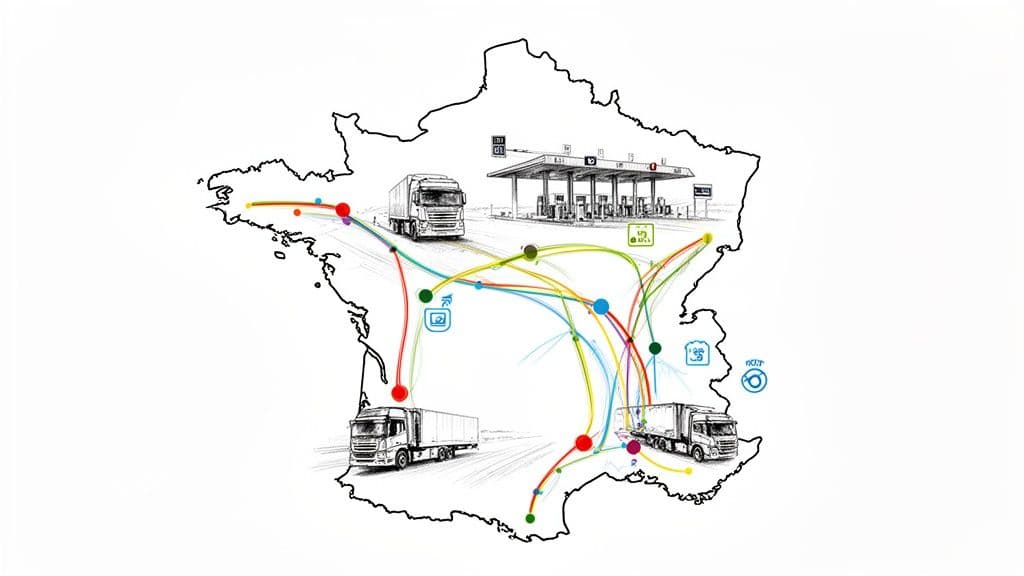
The best fuel card for a company in France depends on the route, vehicle type and back-office workflow. A local van fleet may care most about supermarket forecourts and simple VAT invoices. A transport company needs motorway density, tolls and HGV-friendly stations. A mixed fleet needs fuel, EV charging, tolls, parking and receipts in one place.
This guide sets out the criteria French businesses should score cards against in 2026, with a special focus on multi-enseigne acceptance, EV readiness and admin work. Use it as a scoring sheet rather than a shortlist: the same card can be the right answer for one depot and the wrong answer for the next.
We build Rally, so we are not pretending to be a neutral publisher. The goal is to give you the questions worth asking, then explain the Rally workflow and the checks a pilot should cover.
How to choose a fuel card in France, at a glance
| If you want… | What to score | Why it matters |
|---|
| Fuel where your drivers actually stop | Station acceptance by road type | Detours cost more than a per-litre discount |
| Diesel for heavy vehicles | HGV and truck-only network access | Light-vehicle forecourts often cannot take an articulated lorry |
| Journeys beyond the border | Cross-border coverage and pricing | Coverage that stops at the frontier splits your reporting |
| Money back on fuel tax | TVA and TICPE invoicing | Refunds depend on the paperwork, not the pump |
| Fewer toll admin streams | Télépéage handling | Tolls become a second invoice trail if left separate |
| A gradual EV transition | Charging roaming across French networks | Mixed fleets need both energies on one workflow |
| Control over who spends what | Driver identification and limits | Unattributed spend is the hardest to challenge |
| A discount that survives contact with the invoice | Fees, deposits and service charges | Monthly charges quietly erase headline savings |
| One card for fuel + EV + tolls + expenses | Rally | Visa-backed acceptance and WhatsApp receipts; prepaid has no refundable security deposit or personal credit check, with business/representative verification |
1. Acceptance across the roads you actually drive
Acceptance is the criterion that decides real cost. A card that is generous on motorways and thin in towns forces urban drivers into detours; a card weighted towards supermarket forecourts can leave long-distance drivers paying motorway prices anyway.
What to check: ask for the accepted-station list as a map, not a count, and overlay it on a week of your own routes. Look separately at motorway service areas, urban stations, supermarket forecourts and rural pumps, and check opening hours and unattended sites for early or late shifts.
Watch out: a multi-enseigne card is only multi-enseigne where you drive. Network size across France says little about coverage on one corridor.
2. Heavy goods and truck-specific networks
Heavy vehicles need lanes they can physically enter, high-flow pumps and, often, urea additive at the same island. Truck-only networks exist precisely because general forecourts cannot serve them.
What to check: confirm HGV lane access, high-flow diesel, urea additive availability and any restriction on tank size or single-transaction limits.
Watch out: cards designed for light commercial fleets and employee expenses rarely replace a dedicated heavy-goods diesel network. Fleets running both may legitimately need two products.
3. Cross-border operation
If vehicles cross into neighbouring countries, the card has to keep working, and the reporting has to stay in one place.
What to check: which countries are covered, whether pricing differs abroad, how foreign-currency transactions are converted, and whether foreign purchases appear on the same invoice as French ones.
Watch out: cross-border VAT recovery is a service, not an automatic feature. Establish whether reclaim support is included, charged as a percentage, or left entirely to you.
4. TVA recovery and TICPE refunds
This is where French fuel cards earn or lose their keep. TVA recovery on fuel and the partial TICPE refund available on diesel both depend on evidence you can produce months later.
What to check: ask your accountant or claim preparer which purchases, vehicles and activities qualify under the applicable TVA and diesel-excise refund rules. Keep the supplier invoices or qualifying receipts and the required fuel, date, quantity and vehicle evidence. A card statement or accounting export is not automatically a supplier tax invoice or proof of refund eligibility.
Watch out: a monthly statement or VAT summary is convenient but of little use if it does not break down by vehicle. Ask for a sample before signing, and pass it to whoever files the claim.
5. Tolls and télépéage
French motorway tolls are a second spend stream, and how a card handles them varies more than anything else on this list.
What to check: whether tolls run on the same account as fuel, whether a separate télépéage badge is required, what the badge costs monthly whether or not it is used, and how the toll charges reach your accounting.
Watch out: badge subscriptions are usually billed per vehicle per month. For vehicles that use motorways occasionally, a per-vehicle badge fee can cost more than the tolls.
6. EV charging roaming across French networks
Charging is where "supported" hides the most variation. Public charging in France is split across many operators, and a card is only as good as the roaming agreements behind it.
What to check: which French charging networks are reachable, whether rapid charging on motorway corridors is included, how pricing works (per kWh, per session, or with idle fees), and whether home charging by employees can be reimbursed through the same workflow.
Watch out: a fuel card with a charging add-on often produces a separate charging invoice. If you are running petrol, diesel and electric at once, insist on one invoice and one report across all three.
7. Spend controls and driver identification
Controls are what turn a payment card into a fleet tool, and they are worth testing before rollout rather than after the first disputed transaction.
What to check: per-driver and per-vehicle limits, restrictions by product category, time-of-day and day-of-week rules, transaction and litre caps, PIN or mileage prompts at the pump, and real-time alerts for out-of-policy spend.
Watch out: a card issued to a vehicle tells you nothing about who filled it, and a card issued to a driver tells you nothing about which vehicle received the fuel. If you need both facts, confirm the card captures both.
8. Fees, deposits and accounting exports
Headline discounts are the easiest number to compare and the least reliable. Build the real cost from the fee schedule, then check what happens to the data afterwards.
What to check: card issuance and replacement fees, monthly account and per-card charges, transaction or service fees, invoicing frequency and payment terms, any security deposit or bank guarantee, and any personal guarantee attached to the account.
For the back office, confirm the card exports structured, VAT-ready files rather than a spreadsheet you have to rebuild. Test a CSV, Excel, JSON or DATEV-format download with your accountant, including document access, original currency and allocation fields. Our accounting page explains the workflow.
Watch out: a discount quoted against a national average is not a discount against the price you would have paid at the station you actually use.
Test one French route and one cross-border journey
Choose real stops from your schedule. Record the result rather than treating a national station count as proof that the route works.
| Test | Evidence to retain |
|---|
| Local or supermarket forecourt | Successful authorised purchase, receipt, actual price and any detour |
| Unattended stop | Opening hours, terminal acceptance and any authorisation hold |
| HGV stop where relevant | Physical access, suitable pump and transaction limit |
| Toll or charging stop | Supported payment method, any separate badge or app, tariff and supplier document |
| Purchase outside France | Country, original currency, settlement amount and accountant-reviewed evidence |
| Accounting handover | Downloaded file, allocation fields and accessible source documents |
Record purchase costs and fees separately from funds held for future spending. Use the no-deposit guide for the funding distinction and the pending transaction example for authorisation headroom. Agree how the team will handle a declined payment before sending drivers onto the route.
Where Rally fits
Rally gives French and European fleets a Visa-backed card for fuel, EV charging, tolls, parking and approved business spend. Test eligible purchases at Visa-accepting locations on your actual routes; available funds, card controls and terminal authorisation still apply. Receipts are captured over WhatsApp, controls are set per driver or vehicle, and finance gets one dashboard and one accounting workflow. Rally is prepaid, with no refundable security deposit or personal credit check. Business and representative verification still applies, and the business funds its balance before spending.
Best for: mixed fleets that want broad acceptance, EV charging and tolls without juggling separate cards.
Watch out: HGV fleets that require dedicated toll boxes may still need a specialist OBU provider for that part of the route.
More: Fuel cards · Compare fuel cards · Book a demo
The bottom line
Score cards against your own operation in this order: acceptance on the roads you drive, then the fuel types and vehicle sizes you run, then TVA and TICPE invoicing, then tolls, then charging, then controls, then fees. A network-led card is the right answer when your routes genuinely fit one network and your vehicles are all the same shape. Choose Rally if you want one Visa-backed card for fuel, EV charging, tolls, parking and expenses across France and Europe, without forcing drivers into one network.