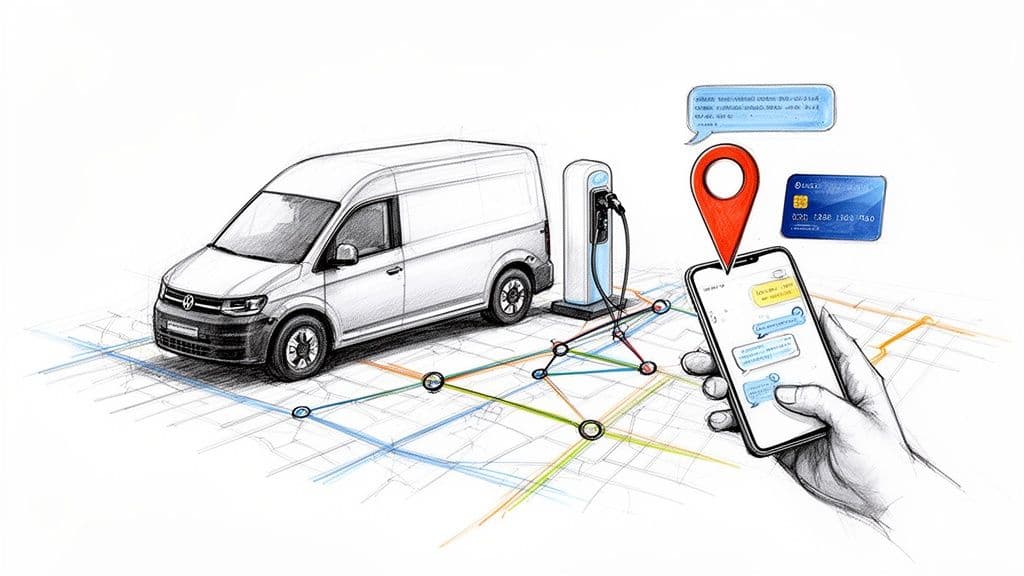
On the surface, an EV charger locator seems simple: a map showing nearby charging points. But for a commercial fleet operating across Europe, relying on a basic consumer app is a fast track to costly delays, driver frustration, and a mountain of paperwork.
The real challenge isn't just finding a charger. It's about finding the right one—the one that’s working, available, cost-effective, and accepts your payment method—without bogging down your drivers and your finance team.
Why a Standard EV Charger Locator Fails Your Fleet
Shifting a commercial fleet to electric vehicles in Europe comes with a unique set of headaches that consumer apps were never designed to solve. Fleet managers quickly discover that a standard EV locator is a blunt instrument for a job that demands surgical precision.
The biggest issue? The European charging landscape is fragmented and notoriously unreliable. Too often, drivers are sent on wild goose chase to stations that are broken, already in use, or have the wrong connector. In a world of tight delivery windows, this unreliability is a massive operational risk you can't afford.

The True Cost of Inefficiency
Across an entire fleet, these small problems multiply into an administrative nightmare. Each charging network demands its own app, its own payment method, or its own RFID card. Before you know it, you're drowning in dozens of invoices, trying to piece together expenses from countless providers.
This is exactly where a consolidated solution becomes a necessity, not a luxury.
Rally turns that chaos into a single, streamlined process. Instead of juggling a dozen tools, your fleet gets one Visa-backed card for fuel, tolls, parking and even office supplies, and you pay for charging with the same card in the charging app of your choice. Putting every expense in one place can save up to 20 hours of manual admin work a month.
Navigating Europe's Complex Charging Network
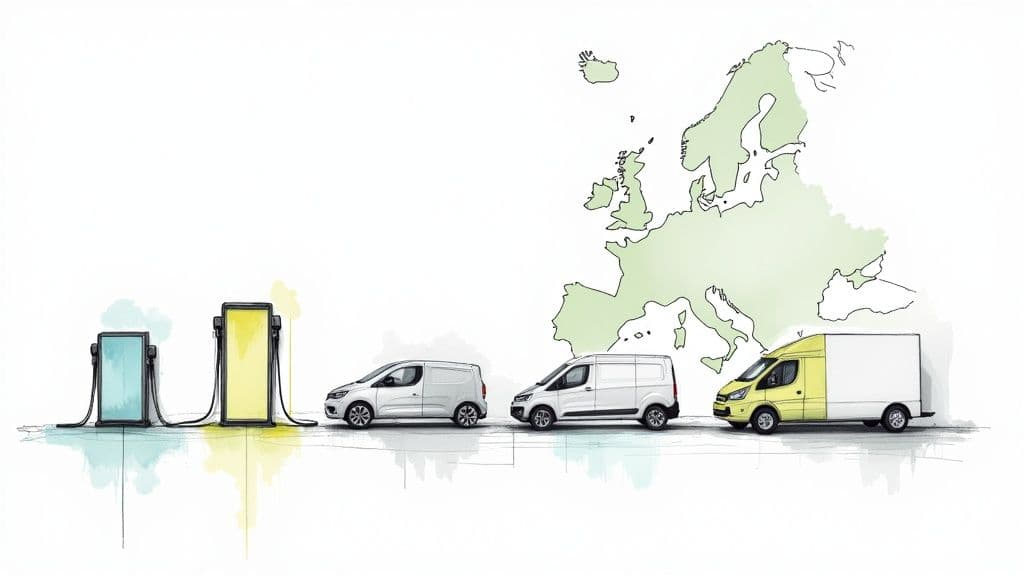
The European market is a minefield of different networks and cross-border quirks. A driver’s route from Berlin to Brussels could easily involve three or four different charging providers, each with its own pricing and access rules. This creates significant payment and invoicing headaches.
You can see this complexity even within a single city. London, for instance, dominates the UK's charging scene, with 38.7% of the national market share. It boasts an impressive density of 150-160 charging devices per 100,000 residents. But navigating that density requires precise, reliable data, not just a bunch of pins on a map. You can learn more about the UK's charging station distribution in our deep dive.
An effective EV charger locator for fleets isn't just a map—it's a strategic tool. It’s about controlling expenses, keeping schedules on track, and crushing the administrative burden. It turns a logistical nightmare into a competitive edge.
Rally does not run its own charging network. Add the Rally card to the charging app of your choice and pay with it, like at the pump, then send the receipt through WhatsApp. Drivers keep the apps and access methods they already use, with one payment card behind them.
What to Look for in a Fleet-Grade Charger Locator
Not all charger locators are created equal, especially when your business depends on them. When you’re vetting an EV charger locator, you have to look past the number of pins on a map and dig into the quality and reliability of the data powering them. For any fleet running routes across Europe, that means focusing on the details that consumer apps almost always gloss over.
A true fleet-grade solution delivers more than just a location; it provides real-time, actionable intelligence. We’re talking live charger status (is it available, in use, or broken?), verified charging speeds, and precise connector types. Without that level of accuracy, you’re just sending your drivers on expensive, time-wasting wild goose chases.

Unifying Cross-Border Coverage and Payments
The European charging market is notoriously fragmented. A single journey across a border can mean dealing with a half-dozen different network providers, each with its own app, RFID card, and payment system. This is a logistical nightmare for drivers and a billing headache for your back office. An effective fleet locator has to cut through that complexity with seamless, unified access.
This is where a single card helps. Rally does not run its own charging network: add the Rally card to the charging app of your choice and pay with it, so drivers do not need a separate payment method for every operator. Check which payment methods the chargers on your routes accept before you roll it out.
Charging paid with the Rally card appears next to the rest of your fleet spend, so finance reviews one set of records instead of piecing together expenses from multiple providers. If you want a deeper dive into your options, check out our guide on finding the right fleet EV chargers.
Before we go further, it's worth understanding the difference between what a basic consumer app offers and what a commercial fleet truly needs.
Essential Features of a Fleet-Ready EV Charger Locator
| Feature | Standard Locator (Consumer Grade) | Fleet-Ready Locator (Commercial Grade) |
|---|
| Data Source | Crowd-sourced or basic network feeds | Verified, real-time data from network operators |
| Charger Status | Often delayed or inaccurate (e.g., shows 'available' when broken) | Live, reliable status (available, in-use, out-of-order) |
| Payment Method | Requires multiple apps and credit cards per network | One company card added to the charging app of your choice |
| Pricing Info | Basic cost estimates, often excluding session fees | Transparent tariffs with energy, session and idle fees shown up front |
| Coverage | Patchy, focused on major urban centres | Comprehensive, including key commercial routes and border areas |
| Integration | Standalone app, no connection to fleet systems | Integrates with telematics and routing; exports accounting files |
| Driver Experience | Complex logins, multiple apps, frustrating interface | One payment card and a simple process, with no separate account for every network |
| Support | Community forums or basic email support | Dedicated 24/7 fleet support for driver issues |
A fleet-ready locator is less of a map and more of a mission-critical operational tool, designed to prevent downtime and control costs from the outset.
The Importance of Reliable and Growing Networks
The public charging infrastructure is expanding at an incredible pace. In 2023, the EU saw a 41.7% increase in public charging points, adding 150,000 new stations to bring the total to over 630,000. This growth, especially in the ultra-rapid charger category, makes it crucial to have a locator that keeps up. You can see more on the UK's infrastructure boom in a detailed report from electrive.com.
A top-tier EV charger locator doesn't just show you where chargers are now; it integrates seamlessly with your operations to show you the most efficient, cost-effective, and reliable options every single time. It should simplify, not complicate.
Rally does not run its own charging network. As the public network grows, add the Rally card to the charging app of your choice and pay with it, like at the pump. Drivers do not need a separate payment method for every operator.
Beyond Location Data to Actionable Insights
Ultimately, a fleet-grade EV charger locator should be the central nervous system for your entire charging strategy. It needs to knit payments together, crush administrative work, and deliver data that actively helps you save money.
Here are the non-negotiable features you should demand:
- Unified Payment System: A single card that works with the charging apps you use is a must. Rally's Visa-backed card goes even further, covering all on-the-road expenses—from fuel to tolls and parking—and you pay for charging with it in the charging app of your choice.
- A Simple Driver Experience: Keep it simple. Drivers should pay with one card and send receipts through the messaging app they already use, so every driver, regardless of tech-savviness, can get the job done easily.
- Transparent Prices: Your locator should guide you to value. Look for tariffs that show energy, session and idle fees up front, so you can compare charging options before you send drivers out.
- Powerful Dashboard: The data has to flow back to you. A centralised dashboard is critical for analysing spending, spotting savings opportunities, and preparing downloadable accounting files.
By focusing on these core functions, you'll choose a solution that does more than just find chargers. You'll get a partner that actively prevents costly delays and transforms charging from a logistical headache into a streamlined, cost-controlled part of your operation.
Streamlining Payments and Eliminating Admin Work
Having reliable data from an EV charger locator is only half the battle. The next, and often more painful, challenge is dealing with the fragmented payment landscape across Europe. This is where data meets action, turning a simple map into a powerful tool for financial control and operational efficiency.
The real goal is to move beyond just finding chargers to creating a single, unified workflow. Imagine a system where charging payments are handled with the same ease as fuel, tolls, parking, or any other business expense. This isn't just a convenience; it's a strategic necessity for any fleet looking to scale its EV operations without drowning in paperwork.
This consolidation is the key to unlocking serious time savings. By bringing all expenses onto one platform, fleet managers can save up to 20 hours of manual admin work every month. The endless cycle of chasing down invoices from dozens of different charging networks gets much shorter when every payment sits in one place.
A Single Card for Every Fleet Expense
The most effective way to cut through this complexity is to centralise all payments onto one card. A single, Visa-backed card that handles fleet expenses—from fuel to parking, tolls and even office supplies, plus charging paid through the charging app of your choice—means drivers no longer need to juggle multiple cards or dip into their own pockets for company business.
With a solution like Rally, you get a few critical advantages:
- Broad Acceptance: Rally reports 99% Visa acceptance across eligible merchants in Europe; actual charging acceptance depends on the operator and payment method.
- Fuel at the Pump Price: Fuel is paid at the pump price, and you pay for charging with the Rally card in the charging app of your choice.
- Transparent Budgeting: Rally uses clearly disclosed fees. It is prepaid, with no refundable deposit or personal credit check.
Preparing files for accounting
Beyond the charging process itself, an effective system needs to give finance clean records. This is crucial for managing and accounting for all charging expenses, especially when your fleet operates across multiple countries, entities, and VAT regimes.
A system with matched receipts and downloadable accounting exports is a genuine game-changer. Rally, for instance, prepares VAT-ready files from card transactions, including charging paid with the Rally card, which reduces manual data entry and the errors that come with it.
The ultimate goal is to create a closed-loop system: a driver charges their vehicle, the payment is processed automatically, and the transaction appears instantly on a central dashboard, fully categorised and ready for your accounts team.
This level of integration gives managers and finance teams a powerful dashboard to analyse spending, track fuel and energy efficiency, and spot new savings opportunities in real time. For a deeper look at how this works in practice, explore our complete guide to electric car charging cards in Europe.
Instead of treating EV charging as a separate, problematic expense category, a unified system brings it into the fold, giving you total visibility and control over every pound and euro spent on the road.
Building a Charging Process Your Drivers Will Actually Use
The best EV charger locator in the world is completely useless if your drivers find it a pain to use. Getting high driver adoption isn’t about flashy features; it’s about making the entire process, from finding a station to plugging in, ridiculously simple. This is where so many fleet managers in Europe hit a wall, facing pushback from drivers who are just plain tired of juggling multiple apps, forgotten passwords, and glitchy software updates.
The real enemy here is friction. Every extra step—downloading an app, creating an account, entering payment details—is another chance for things to go wrong and throw a delivery schedule off track. If you want to build a system that actually works in the real world, you have to kill those pain points and design a workflow that feels effortless for the people behind the wheel.
Keeping the Charging Workflow Simple
Picture this: your driver pulls up to a charging station. Charging access varies by network, so the simplest process is the one with the fewest new steps. The driver pays with the company card they already carry and sends the receipt through WhatsApp, something they already know and use every single day.
Rally does not run its own charging network. Add the Rally card to the charging app of your choice and pay with it, like at the pump. That keeps the process simple:
- One Card, Not One per Network: Drivers pay with the Rally card instead of collecting a separate payment method for every operator.
- Receipts Through WhatsApp: Drivers send the charging receipt through WhatsApp, so there is no separate expense app to install or log in to.
- A Familiar Routine: The steps match what drivers already do at the pump: pay with the card and keep the receipt.
This workflow shows just how charging, payment, and expense management can be rolled into one seamless process.

The key takeaway is that by bringing all these steps together, you lift the administrative weight off both your drivers and your back-office team.
The On-the-Road Workflow in Action
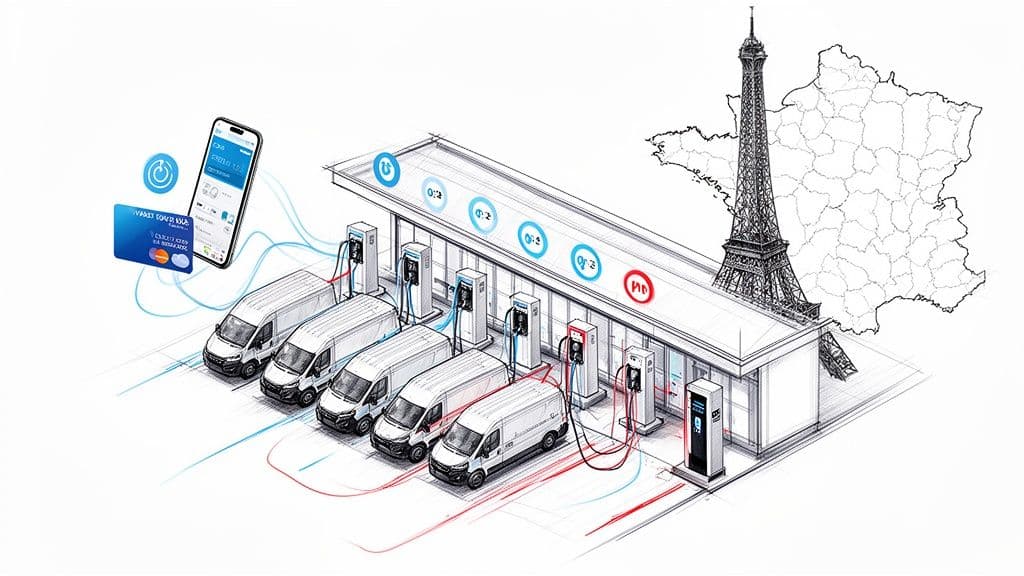
Let’s walk through a typical scenario. A delivery driver in France is running low on charge. They use the fleet’s integrated locator to find a compatible station.
When they arrive, the driver plugs in, starts the session in the charging app of their choice and pays with the Rally card. Once charging is done, they send the receipt through WhatsApp, and the transaction is matched on the central dashboard, ready for the accounts team.
The best processes are invisible. When drivers can charge and pay without even thinking about it, you've won. That simplicity translates directly into better route efficiency and less vehicle downtime.
This frictionless experience isn't just for charging. It covers all on-the-road expenses—parking, tolls, even day-to-day business supplies—all through a single, Visa-backed card. By consolidating these tools, you don't just make life easier for your drivers; you give managers instant visibility into spending and can save up to 20 hours of manual admin work every month. The result is a charging process that is simple for everyone.
Unlocking Cost Savings Across Your European Routes
Finding an available charger is one thing, but finding the most cost-effective one is what really moves the needle for your bottom line. A smart EV charger locator should do more than just point drivers in the right direction; it needs to actively guide them to the cheapest charging options, turning a daily task into a serious cost-control strategy.
This is a huge deal in Europe, where electricity prices can swing wildly between networks, countries, and even by the time of day. Without real-time pricing and a single way to pay, fleets often end up paying far more than they should. A targeted approach here can deliver some pretty substantial returns.
Finding Lower-Cost Charging
It all boils down to paying less per kilowatt-hour (kWh). Compare the tariff for each access method, including energy, session and idle fees, before you send drivers to a charger. Rally does not set charging prices: you pay the operator's tariff with the Rally card in the charging app of your choice.
With clearly disclosed fees, budgeting becomes more predictable. Rally is prepaid, with no refundable deposit or personal credit check.
This simplified financial model gets rid of a major headache for fleet managers, freeing up capital and cutting down on admin. If you're looking to streamline other parts of your business, our guide on integrated company expense cards has some great insights.
From Data to Actionable Savings Insights
True cost optimisation goes way beyond just finding a cheap plug. It's about digging into your fleet’s charging patterns to find those hidden opportunities to save even more. For this, a powerful dashboard is absolutely essential, turning raw transaction data into clear, actionable insights you can use to manage energy expenses like a pro.
With everything in one place, you can:
- Track Charging Spend: Keep a close eye on your actual charging costs across different regions, networks, and individual drivers. This is how you spot the high-spend areas that need attention.
- Review Charging Behaviour: Get a real understanding of when and where your drivers are paying for charging. This data can help you shift charging to off-peak hours when rates are lower—a simple change that can cut your costs.
- Identify Low-Cost Spots: Use historical transactions to pinpoint the most economical charging spots along your most frequent routes. This lets you build a data-driven charging policy that your drivers can actually follow.
This level of detail lets you shift from being reactive to proactive. By truly understanding your fleet's unique energy habits, you can make smarter decisions that continuously drive down your operational costs, turning your EV charger locator into an essential financial tool.
Got Questions About Fleet EV Charging? We've Got Answers
Making the switch to an electric fleet naturally brings up a lot of "what if" scenarios. Fleet managers across Europe are asking the same practical questions about payments, driver adoption, and how to keep costs under control. Here are some straight answers based on what we see every day.
How Does Cross-Border Charging Work in Europe?
This is a massive headache for most fleets. A driver heading from Germany into France might have to juggle multiple apps and payment cards just to find a compatible charger. It’s chaotic and inefficient.
We built Rally to cut through that mess. Rally does not run its own charging network. Add the Rally card to the charging app of your choice and pay with it, like at the pump, so drivers do not need a payment method for every operator.
Do My Drivers Really Need to Download Another App?
It depends on the network. Many operators need their own app or account, so check what each charger on your routes supports. Rally does not add another app: add the Rally card to the charging app you already use and pay with it, then send the receipt through WhatsApp.
How Can We Actually Control and Track Our Charging Costs?
Real cost control isn't just about finding an EV charger locator; it's about having a single, reliable source of truth for every single expense. Instead of drowning in invoices from dozens of different charging networks, Rally pulls every transaction—whether it's for charging, tolls, parking, fuel, or even office supplies—into one clear, powerful dashboard.
This is where the magic happens. By seeing all your spending patterns in one place, you can finally spot the high-spend areas and optimise routes.
Better yet, we've automated the back-office work. With direct integrations into most European accounting systems, the process can save clients up to 20 hours in manual admin every month. Fees are disclosed clearly. Rally is prepaid, with no refundable deposit or personal credit check.
Ready to make your fleet's EV charging simpler and bring all your expenses under one roof? Rally gives you one Visa-backed card, receipts through WhatsApp and the unified dashboard you need to cut admin. Learn more and see how it works today.