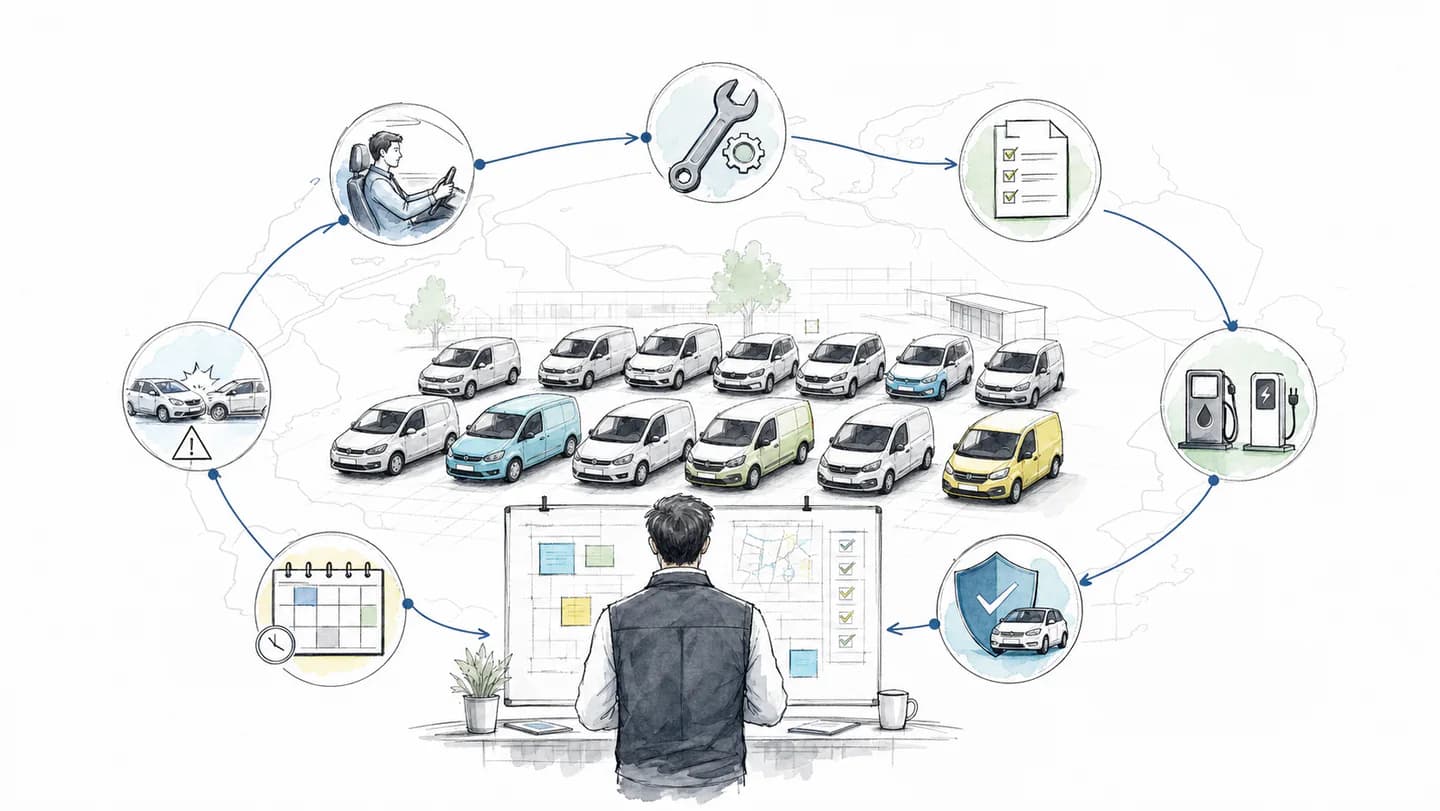
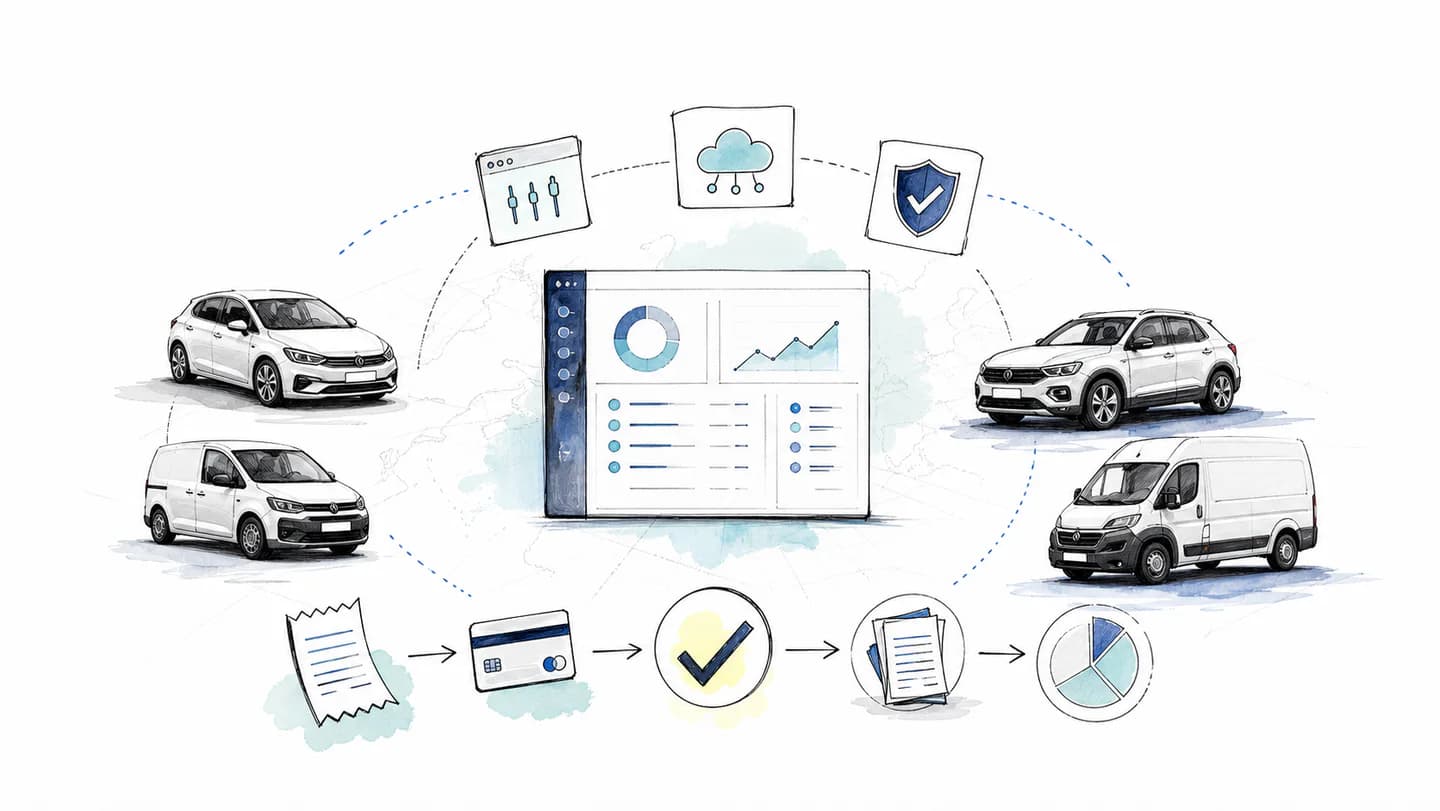
The best fleet management practice for a growing fleet is to run one repeatable operating system: a single vehicle register, named owners, clear spending rules, automated document collection, and a short weekly and monthly review. The problem is rarely a lack of data. It is that the data sits across cards, spreadsheets, inboxes and people's heads—and the gaps widen every time the business adds vehicles, drivers, entities or countries.
This guide is an operational playbook rather than a list of software features. If you are comparing platforms, start with Rally's expense management software page. Here, the goal is to show exactly what a growing fleet should do, who should own it, and how often it should happen.
The fleet management checklist
Use this as the minimum operating cadence for a growing fleet.
| Cadence | Review | Owner | Action |
|---|
| Daily | Declined cards, unusual spend, breakdowns and overdue driver actions | Fleet operations | Resolve anything that could stop a vehicle or driver working |
| Weekly | Missing receipts, fuel or charging outliers, maintenance due soon and unresolved exceptions | Fleet manager | Assign each exception and give it a due date |
| Monthly | Cost per vehicle, cost per kilometre or mile, downtime, compliance and budget variance | Fleet manager + finance | Investigate outliers and change one policy or process |
| Quarterly | Supplier pricing, vehicle utilisation, insurance, contracts and replacement plan | Operations + finance | Renegotiate, reallocate or retire underperforming assets |
| Annually | Fleet policy, vehicle mix, electrification plan and total cost of ownership | Leadership | Set the next year's fleet budget and operating targets |
The important part is not the exact meeting schedule. It is that every recurring task has a trigger, an owner and an escalation path. Without those three things, a dashboard becomes another place to look rather than a system that gets work finished.
1. Keep one vehicle and driver register
Start with a definitive register for every vehicle and driver. A small fleet may survive with three spreadsheets; a growing fleet will eventually make decisions using three different versions of the truth.
For each vehicle, record:
- Registration and vehicle identification details
- Make, model, fuel or energy type and acquisition date
- Lease, finance or ownership status
- Assigned driver, team, cost centre and legal entity
- Insurance, inspection, service and contract renewal dates
- Odometer, current status and usual operating region
- Fuel, charging, maintenance, toll and other running costs
- Links to the relevant contracts, invoices and compliance documents
For each driver, record their assigned vehicle and card, licence status, required checks, business entity, spending policy and any open actions.
Do not duplicate the same field in multiple systems unless an integration keeps it synchronised. Choose a system of record for each data type, document that decision, and make one person responsible for data quality.
2. Give every recurring task an owner and escalation rule
"Fleet team" is not an owner. Name the role responsible for each workflow, even if one person currently holds several roles.
A simple responsibility map could look like this:
| Workflow | Primary owner | Escalate when |
|---|
| Vehicle documents and inspections | Fleet manager | A required document is missing or a deadline is within 14 days |
| Driver licence checks | Fleet manager or HR | A check is incomplete by its due date |
| Fuel and charging policy | Fleet manager | A driver or vehicle repeatedly breaches the policy |
| Receipts and coding | Finance operations | A transaction remains unmatched at month end |
| Supplier and lease renewals | Procurement or operations | A renewal window opens without a decision |
| Vehicle replacement | Operations + finance | Cost, downtime or utilisation crosses an agreed threshold |
Write down who can approve an exception, who contacts the driver, and when an unresolved item reaches a director. This removes the most common source of delay: everybody seeing a problem, but nobody being responsible for the next step.
3. Manage maintenance before it becomes downtime
Preventive maintenance is not only a calendar of service dates. It is a process that connects mileage, driver reports, workshop bookings, parts availability and vehicle cover.
For each vehicle:
- Define the manufacturer service interval and any usage-based checks.
- Create reminders far enough in advance to book a workshop without disrupting the route plan.
- Ask drivers to report warning lights, damage and tyre issues through one familiar channel.
- Track when the vehicle went off the road, why, and when it returned.
- Review repeat faults and compare repair cost with the replacement threshold.
Measure both planned and unplanned downtime. A cheap repair is not cheap if a van misses two days of work and forces expensive replacement transport.
For a growing fleet, a two-stage reminder works well: an early warning for planning, followed by a short escalation window for action. The task should stay open until the workshop is booked or an authorised person records why it was postponed.
4. Put spending policy into the payment workflow
A PDF fleet policy cannot prevent an out-of-policy purchase. Translate the policy into controls that apply when the transaction happens.
Set rules for:
- Allowed expense categories, such as fuel, tolls, parking and maintenance
- Per-transaction, daily and monthly limits
- Permitted fuel grades or charging services
- Merchant, location and time restrictions where appropriate
- Who can approve emergency or exceptional spend
- What evidence the driver must submit
Use different policies for different operating groups. A long-distance driver, a local service engineer and an office employee should not share the same limits simply because they work for the same company.
Review declines as carefully as approved spend. Too many legitimate declines create driver frustration and workarounds; too few declines may mean the rules are not doing anything. The goal is a policy that catches genuine exceptions without interrupting normal work.
Rally applies per-card limits and category controls to fuel and other road expenses. The wider expense management platform connects those transactions to the relevant driver, vehicle, documents and accounting workflow.
5. Manage fuel and EV charging as one energy budget
Mixed fleets often split fuel and charging into separate reports, suppliers and owners. That makes it difficult to compare the actual operating cost of a diesel van with an electric replacement.
Create one energy view that includes:
- Litres of fuel and kilowatt-hours charged
- Total energy cost per vehicle
- Cost per kilometre or mile
- Public, workplace and home-charging costs
- Fuel or charging location
- Idle fees, premium fuel and other avoidable charges
- Missing or unmatched sessions
Keep the source data detailed even if management only needs a summary. Fleet managers need to be able to move from a monthly outlier to the transaction, driver and vehicle that caused it.
For fuel-heavy fleets, our guide to reducing fleet fuel costs ranks the most useful cost levers. For mixed and electric fleets, keep charging and fuel records in the same expense workflow. Explore Rally company cards for managing approved business spend.
6. Automate receipts, invoices and accounting handoffs
Receipt chasing becomes a full workflow once a fleet reaches a few dozen vehicles. The scalable process is:
- Capture the receipt through a channel the driver already uses.
- Extract the date, merchant, amount, VAT and relevant cost allocation.
- Match it to the card transaction, vehicle and driver.
- Flag only mismatches, missing evidence and unusual tax treatment.
- Export validated data as accounting files.
- Keep the original document and an audit trail of any correction.
This is where automation should remove work, not merely move it from a spreadsheet into another queue. Rally's AutoMatch ingests receipts, invoices, charging sessions and contracts, then matches and structures the data for accounting. Rally's 2026 production data shows that AutoMatch processes at least 97% of documents automatically and reduces errors reaching the ledger by more than 80%.
For a closer look at the finance workflow, read our guide to European fleet expense management or the fleet accounting platform.
7. Make driver workflows easier than the workaround
Drivers should not need to remember several apps, passwords and portals to complete basic fleet tasks. Every extra step reduces compliance.
Design driver workflows around the moment the action happens:
- Prompt for an odometer reading after a relevant transaction.
- Ask for a receipt immediately, not at the end of the month.
- Send licence and document reminders before the deadline.
- Give the driver a clear way to report damage or a card problem.
- Confirm when an action is complete so they do not repeat it.
Keep the request short and explain what is needed. "Send the receipt for your €84.20 fuel purchase at 14:32" is more actionable than "You have an outstanding expense."
Rally uses WhatsApp for receipt collection, odometer prompts, driver check-ins and other fleet workflows. DriverLink shows how linking the driver to the card improves attribution without asking them to learn another app.
8. Track a small set of fleet metrics that lead to action
More metrics do not create better management. Choose measures that reveal a decision you can make.
| Metric | What it tells you | Useful next question |
|---|
| Total cost per vehicle | Whether the asset is economical overall | Which vehicles are above their peer group, and why? |
| Energy cost per kilometre or mile | Fuel or charging efficiency | Is the variance caused by route, vehicle, driver or buying behaviour? |
| Planned vs unplanned downtime | Maintenance quality and operational impact | Which faults or suppliers cause repeat downtime? |
| Vehicle utilisation | Whether capacity matches demand | Can a vehicle be reassigned or removed? |
| Spend-policy exception rate | Whether controls are effective and usable | Is this misuse, a bad rule or an operating need? |
| Receipt match rate | How clean the accounting workflow is | Which drivers, merchants or expense types create exceptions? |
| Compliance actions overdue | Near-term legal and operational risk | Who owns each overdue action? |
Compare like with like. A refrigerated truck should not be benchmarked against a city car, and an EV charged mainly at motorway rapid chargers should not be compared blindly with one charged at a depot.
Set an expected range for each vehicle group. Investigate material exceptions rather than rewarding teams for moving an average by a fraction.
9. Turn compliance dates into active workflows
Compliance varies by country, vehicle type and operating model, so your process must be configurable. At a minimum, connect each required check or document to:
- The relevant vehicle, driver, entity and jurisdiction
- A responsible owner
- An expiry or review date
- An early reminder
- Evidence that the check was completed
- An escalation if the action remains open
Do not treat a reminder as completion. "Email sent" is not the same as a renewed insurance certificate or a completed licence check.
Rally's compliance and renewals capabilities are currently in early access. They are designed to track expiries, request missing documents over WhatsApp, prepare follow-ups and escalate unresolved items, with consequential actions kept under human approval.
10. Run one monthly fleet operating review
A monthly fleet review should take 45–60 minutes and end with named actions. It is not a tour of every dashboard.
Use this agenda:
- Safety and compliance: overdue checks, incidents and upcoming deadlines.
- Availability: breakdowns, unplanned downtime and maintenance due.
- Cost: total spend, cost per vehicle and the largest variances.
- Fuel and charging: price, consumption and avoidable fees or detours.
- Driver and payment exceptions: repeated policy breaches, declines and missing evidence.
- Capacity: underused vehicles, new demand and planned replacements.
- Actions: owner, due date and escalation for every decision.
Start the next meeting by reviewing the previous action list. If the same issue appears for three months, change the process rather than discussing it again.
A 30-day implementation plan
You do not need a six-month transformation project to create a fleet operation that can scale. Build the operating rhythm in four weeks.
Week 1: Establish the baseline
- Build or clean the vehicle and driver register.
- List every supplier, card, spreadsheet, inbox and system involved.
- Record current costs, downtime, overdue actions and missing documents.
- Name an owner for each recurring workflow.
Week 2: Define policy and thresholds
- Create driver and vehicle groups.
- Set spend rules and an exception-approval process.
- Agree maintenance and compliance reminder windows.
- Choose five to seven monthly metrics and expected ranges.
Week 3: Automate the repetitive handoffs
- Connect payment, receipt and accounting data where possible.
- Replace end-of-month receipt chasing with immediate prompts.
- Create early reminders and escalation rules for critical dates.
- Test the workflow with one team or vehicle group before wider rollout.
Week 4: Run the first operating review
- Review exceptions rather than every record.
- Fix broken rules that create legitimate declines or false alerts.
- Assign actions for cost, downtime and compliance outliers.
- Record the baseline so next month's review shows whether the changes worked.
If your software still requires staff to copy the same vehicle, driver or transaction between systems, treat that as an open process issue. Rally can build the fleet registry from existing documents and transactions, connect spend to drivers and vehicles, and surface the few decisions that need attention. See how the expense management platform works.
Frequently asked questions
What are the most important fleet management best practices?
Keep one accurate vehicle and driver register, assign every recurring task to an owner, schedule maintenance before downtime occurs, enforce spend policy at the transaction, automate documents and accounting, and review a small set of actionable metrics every month.
When should a growing fleet replace spreadsheets?
The tipping point is often around 5–10 vehicles, when more people update the data, transaction volume increases and missed dates carry real cost. A spreadsheet can remain useful for analysis, but it should not be the only place controlling renewals, documents, assignments and fleet spend.
Which fleet metrics should a growing business track?
Start with total cost per vehicle, energy cost per kilometre or mile, planned and unplanned downtime, vehicle utilisation, spend-policy exceptions, receipt match rate and overdue compliance actions. Add a metric only when somebody owns the decision it informs.
How often should a fleet manager review performance?
Review operational exceptions daily, upcoming maintenance and missing evidence weekly, performance and cost monthly, and suppliers, utilisation and replacement plans quarterly. The cadence should become more frequent when a safety, compliance or vehicle-availability risk is involved.
Which fleet tasks should software automate?
It should automate repeatable collection, matching, reminders and escalation: receipt capture, transaction matching, document filing, upcoming deadlines and routine driver follow-ups. Decisions with legal, financial or operational consequences should remain visible, auditable and subject to human approval.