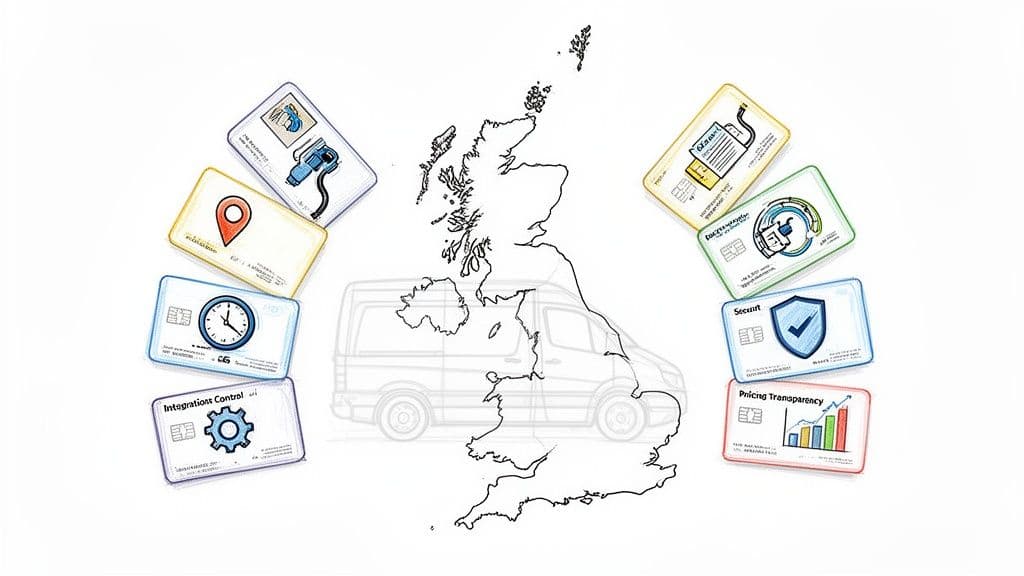
For most German companies, getting a corporate credit card means clearing two separate credit hurdles at once: a Bonitätsprüfung on the business and a personal SCHUFA-Auskunft on the Geschäftsführer. That pairing is fine for an established Mittelstand player with a clean credit history. It is a wall for everyone else — fast-growing GmbHs, founders without thick German credit files, contractors, expanding subsidiaries of foreign parents, and fleet teams that need to issue cards to drivers who have nothing to do with the company's creditworthiness.
The good news is that a parallel category has matured: "Firmenkreditkarte ohne SCHUFA" products that work like company cards in daily use without running a personal credit check on the legal representative. Most are prepaid or charge-style Visa or Mastercard products funded from a corporate balance — and for the use cases most German finance teams actually care about (controlled employee spend, fuel, EV charging, travel, online subscriptions), they cover the same ground as a traditional Firmenkreditkarte. This guide explains what those products actually are, when they are the right pick, which providers are worth shortlisting in 2026, and how to plug them into DATEV without breaking your Steuerberater's monthly close. If you are standing up company expense cards for employees and fleets, this is the German-market angle.
Why German Companies Hit the SCHUFA Wall
The traditional path to a Firmenkreditkarte in Germany runs through a Hausbank or a corporate-card issuer like American Express, and almost every one of them requires a SCHUFA-Auskunft on the Geschäftsführer alongside a Bonitätsprüfung on the GmbH itself. That double check exists because the underwriter is extending real credit — a revolving line, often with a personal guarantee buried in the fine print.
In practice, this filters out a long list of companies with perfectly legitimate spending needs:
- GmbH in Gründung with no trading history yet.
- Founders who moved to Germany recently and do not have a deep SCHUFA file.
- Companies whose managing director has a single negative SCHUFA entry from years ago that has not expired.
- Fast-growing teams that want twenty or fifty employee cards, where the issuer either refuses to scale card issuance or treats every new card as a separate underwriting event.
- Mittelstand businesses with mixed-quality credit — solid revenue but a slow Hausbank, or a recent restructuring that depressed the score.
The result is a familiar pattern: the company has cash in the bank, real revenue, and a real spending need, but the application sits in limbo for weeks because a Bonitätsprüfung is in the queue. Meanwhile drivers pay for diesel out of pocket, sales reps put hotel bills on their personal Visa, and the Buchhaltung drowns in receipts. This is where the "ohne SCHUFA" category gets interesting — not because credit avoidance is the goal, but because the operational pain of waiting is unacceptable.
What "Firmenkreditkarte Ohne SCHUFA" Really Means
A quick honesty break. A "Firmenkreditkarte ohne SCHUFA" is almost never a credit card in the classical German sense — meaning a revolving credit line extended to the business after a full Bonitätsprüfung. If a product really skipped credit underwriting and still gave you a credit line, that would be a regulatory problem.
What you actually get falls into three buckets:
- Prepaid corporate Visa or Mastercard. The company tops up a balance and the cards draw from it. No credit line, no SCHUFA-Auskunft on the director. This is the most common "ohne SCHUFA" model and what most providers actually mean.
- Debit-style corporate cards that settle against a connected Geschäftskonto in real time, like a Visa Debit linked to a business account. Spending is bounded by the account balance.
- Charge cards that settle monthly from a corporate account without extending revolving credit. Some issuers run a lighter Bonitätsprüfung on the company but skip the personal SCHUFA on the Geschäftsführer.
The trade-off is real and worth stating plainly: you do not get a 30–60 day float, you do not earn the same Bonus-Punkte that legacy cards advertise, and you cannot use the card to bridge cash-flow gaps. What you do get is fast issuance (often the same day), no personal credit check, granular per-card controls, and a clean accounting trail. For 80% of corporate spending — employee expenses, fuel, EV charging, software, travel — that trade-off is the right one. For long-tenor working capital, it is not, and you should keep a separate financing instrument for that.
When a No-SCHUFA Company Card Is Right
This product class fits a specific buyer profile. If any of these match you, a no-SCHUFA Firmenkarte is usually a better starting point than fighting through a traditional Bonitätsprüfung:
- Newly incorporated GmbH or UG (haftungsbeschränkt). No trading history yet, but real spend from day one — hosting, ads, travel, office.
- Companies with international founders who do not have a multi-year SCHUFA file in Germany.
- Fast-growing teams issuing 20, 50, or 200 employee cards, where every new card should not trigger a new underwriting event.
- Fleet operators whose drivers need fuel and EV charging cards. The driver's personal SCHUFA is irrelevant; the company needs spend controls, not consumer credit.
- Subsidiaries of foreign parents. A German GmbH owned by a US or UK parent often has a strong balance sheet but no local credit footprint.
- Multi-entity setups. Holding plus operating GmbHs that want cards issued centrally without each subsidiary being underwritten separately.
- Project-specific or seasonal spend. Temporary teams, contractors, event budgets — where the card outlives a single quarter but does not justify a full Hausbank application.
If your use case is funding inventory on a 60-day cycle or floating six-figure marketing spend, you still want a traditional credit instrument. Use both: a no-SCHUFA prepaid Firmenkarte for distributed employee and fleet spend, plus a credit line or Kontokorrent at the Hausbank for working capital.
What to Look For in a No-SCHUFA Firmenkarte
Once you are shopping in this category, the product differences are sharp. Use this checklist as your evaluation grid:
- Issuance speed. Virtual cards in minutes, or a five-day wait for a physical card? For teams scaling fast, virtual-first is non-negotiable.
- Per-card spend limits and MCC restrictions. Can you cap a driver card at €1,500/month, restrict it to fuel and parking MCCs, and disable e-commerce? The answer should be "yes, from the admin dashboard, in seconds."
- Receipt capture. The best products let employees forward a receipt by WhatsApp, email, or photo from a mobile app, and match it to the transaction automatically.
- Accounting integration. DATEV export is the hard requirement in Germany. Bonus points for Lexware, sevDesk, SAP Business One, and a clean CSV export with proper VAT lines.
- Multi-entity support. Can one admin manage cards across multiple GmbHs and produce a consolidated export per entity? Critical for groups.
- Fuel and EV charging. If you have any drivers, a Visa that works at every fuel station and EV charger — not a closed-loop fuel card — collapses your card stack.
- Fee structure. Issuance fees, monthly per-card cost, foreign-exchange markup, interchange handling. Compare total cost of ownership across 12 months at your expected card count.
- Spend policy enforcement. Real-time blocks on transactions that violate policy beat after-the-fact reimbursement clawbacks every time.
- Security and 3D Secure. Visa-backed cards with strong customer authentication, instant card freeze from the admin or driver app, and granular role-based access for finance admins.
Comparing the Major Options in 2026
Five names come up repeatedly in German finance teams' shortlists. None is a credit card in the classical sense; all let you issue corporate cards without putting the Geschäftsführer through a personal SCHUFA check. The right pick depends on whether you also need fuel and EV charging coverage.
| Provider | Card type | SCHUFA on the Geschäftsführer | Fuel & EV charging | DATEV export | Best fit |
|---|
| Rally | Visa, prepaid corporate | No | Native — Visa-backed at every fuel station and EV charger across Europe | Yes | Fleets and mixed teams that want fuel, EV, and employee spend on one Visa |
| Pleo | Mastercard, prepaid / debit corporate | No personal SCHUFA on standard plans | Generic Visa/Mastercard acceptance; no fleet-specific tooling | Yes | Office-heavy teams focused on employee expense management |
| Moss | Visa, debit / charge corporate | Bonitätsprüfung on the company; lighter touch on the director | Generic card acceptance | Yes | German-built buyer experience; established GmbH with clean books |
| Qonto | Mastercard, debit corporate | Light check on the entity; no SCHUFA on the director for prepaid tiers | Generic card acceptance | Yes (via integrations) | Small teams that also want a Geschäftskonto bundled with cards |
| Vivid Money Business / N26 Business | Mastercard or Visa Debit, neobank account | Account-opening check; no traditional Firmenkreditkarte SCHUFA | Generic card acceptance | Partial | Solo founders and very small GmbHs that want a fast Geschäftskonto with a card |
A few caveats worth stating out loud. Moss markets aggressively to German Mittelstand and is a strong fit there, but several of its corporate-card products do run a Bonitätsprüfung on the entity — confirm during sales. Pleo's "ohne SCHUFA" positioning depends on the plan; higher-tier credit products will be underwritten. Rally is the only entry on this list that ships fleet primitives — fuel and EV charging at every station with VAT-line capture — on the same Visa as employee expenses. For a wider feature view, the Rally company expense cards page covers limits, controls, and integrations in full.
Issuing Employee Cards Without SCHUFA Drama
Once you have chosen a provider, the day-to-day reality is what you should optimise for. Four workflows make the biggest difference.
Onboarding a new joiner. From the admin dashboard, create a virtual card with a monthly limit and an MCC restriction in under two minutes. The employee gets it in their wallet app the same day and can pay for travel, software, or fuel without filing a reimbursement. Physical cards follow by post for use cases that need chip-and-PIN at fuel pumps or ticket machines.
Per-employee limits and category restrictions. Every card should carry its own policy: a sales rep gets a €2,000 monthly limit with travel and dining unlocked, a driver gets €1,500 with fuel and parking only, a marketing manager gets €5,000 with online ads enabled. Limits are editable in real time from the dashboard, not "request a change and wait three days." For deeper patterns on policy design and roll-out, see our guide to expense cards for employees.
Off-boarding the same day. When someone leaves, an admin freezes the card from the dashboard before the leaver hands back the laptop. No "we will cancel it at the next billing cycle." This is the single most important security property of a modern Firmenkarte versus a traditional shared card or a personal-card reimbursement model.
Receipts without chasing. Rally lets drivers and employees send a receipt photo to a WhatsApp number, and the transaction is matched automatically. Pleo and Moss use mobile-app capture. Either way, the goal is the same: zero spreadsheets, zero email attachments, zero month-end scramble.
Accounting and DATEV Integration
In Germany, the accounting question is the buying question. If your Steuerberater cannot pull your corporate-card transactions into DATEV cleanly, the product fails — no matter how good the cards look in a demo. A clean monthly handoff looks like this:
- Transactions are captured in real time on the card.
- Each transaction is enriched with a receipt and a VAT line.
- The finance admin reviews exceptions (missing receipts, unmatched transactions, policy violations) inside the provider's dashboard.
- A DATEV export — or a direct DATEV Unternehmen online connection — carries the month's data into the Steuerberater's workflow.
- The Steuerberater books and reconciles in their normal flow without rekeying anything.
Where this breaks down: cards that do not enforce receipt capture leave you with rows in DATEV that the Steuerberater has to query, slowing the close. Cards that do not capture VAT lines properly force manual splits on every cross-border transaction. Cards without multi-entity support force you to run three separate exports for three GmbHs and then merge them by hand.
For the cross-border view — VAT, FX, fuel, tolls, parking, and how all of it should land in your books — our guide to European fleet expense management covers it at depth. And Rally accounting integrations include DATEV alongside Lexware, sevDesk, and the major European stacks.
Fleet Use Case: Cards for Drivers + Office in One Stack
For fleet operators, the no-SCHUFA Firmenkarte question is bound up with the fuel-card question. Most traditional Tankkarten are closed-loop (Aral, Shell, DKV, UTA) and do not help with the rest of an employee's spend. Most expense-card products are Visa-backed but do not think about fleet. Rally sits in the middle: a single Visa-backed corporate card that works as a Rally fuel card at any station, an EV charging card across one of Europe's largest charging networks, and an employee expense card for everything else — all on the same balance, in the same dashboard, with the same DATEV export. For a German fleet with ten drivers and fifteen office staff, that is one card stack instead of three.
2026 Checklist for German Finance Teams
Before you sign anything, work through this:
- Define the use case. Employee expense, fleet, or mixed? The right shortlist is different for each.
- List required integrations. DATEV is mandatory. Add Lexware, sevDesk, SAP Business One, or HR/payroll tools as relevant.
- Evaluate two or three providers in parallel. Real product demos, not just sales decks. Ask to see virtual card issuance live.
- Run a 30-day pilot. Five cards, real transactions, one month of receipts. You will learn more in 30 days than in any vendor pitch.
- Document a spend policy. Limits per role, allowed merchant categories, receipt rules, expense approval thresholds. Encode it in the card, not in a Confluence page.
- Set up DATEV export from day one. Do not postpone the accounting plumbing — it is where most card rollouts stall.
- Train employees once. A 15-minute walkthrough on how to use the card, send receipts, and request a limit change saves months of one-off questions.
- Set a quarterly review. Card count, spend by category, policy violations, receipt-capture rate — adjust based on the data.
A no-SCHUFA Firmenkreditkarte is not a compromise — for most German teams it is the correct primitive. The companies that move fastest are the ones that stop trying to bend a traditional Firmenkreditkarte process around modern spend patterns and pick a tool built for the way work actually happens.
See Rally in action — book a 20-minute walkthrough of fuel, EV charging, and employee expense on a single Visa, with DATEV export included.